


Homemade pasta: the best recipe and essentials
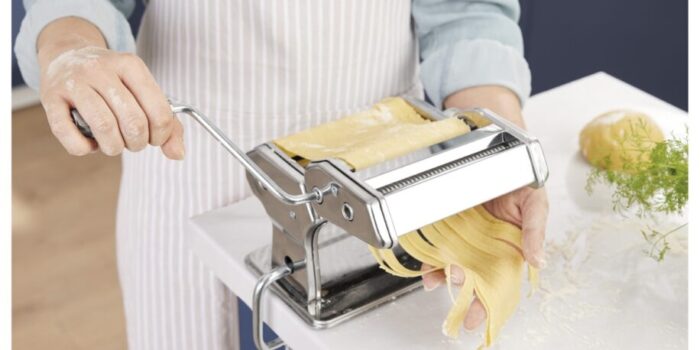
Are you afraid to buy a pasta machine because you think making your own pasta is a huge chore? Fear no more. Making pasta yourself is a great weekend project and much easier than you think. So get a pasta machine (Lidl even sells a pasta machine, and it costs next to nothing) and you’re only a few steps away from the most delicious pasta.

Making pasta yourself
It all starts with the right recipe. Our favorite is Antonio Carluccio’s recipe, which always used a ratio of 1 egg to 100 g flour. This gives you perfectly smooth dough that rolls out well. If you can find tipo 00 flour: great, use it! If not, standard all-purpose flour works perfectly well too. And always add a good pinch of salt.
Kneading
Place the flour in a mound on your work surface and make a well in the center. Crack the eggs into it and add the salt. Mix the flour into the egg mixture little by little with a fork. Once this becomes difficult, use your hands to scrape the dough together and knead for 10–15 minutes until a smooth and even dough forms.
Resting
Always let the dough rest for at least half an hour; longer is fine too. This is important for the dough’s flexibility. During resting, the flour absorbs the water, allowing the gluten to relax and making the dough easier to shape and roll.
Pasta machine
The easiest way to roll pasta is with a pasta machine. They cost around €40 (so the one from Lidl is considerably cheaper) and they really make your life much easier. You can also get attachments for your stand mixer; those are a bit more expensive (and of course, so is a stand mixer itself).
Run the dough through the thickest setting of the pasta machine. Then fold it in half again and run it through the same setting once more. Repeating this process two or three times develops the gluten and gives you smoother dough that is less likely to tear. Now set the pasta machine to a thinner setting and run the dough through again. Keep running the dough through increasingly thinner settings until you reach the desired thickness. I usually stop at setting 7, but for ravioli it can be a little thinner.
Rolling pin
No pasta machine? You can make equally delicious pasta with a rolling pin; it just takes more effort. Roll out the dough on a floured work surface until it is thin enough. How do you know? Hold the dough up to the light and move your hand underneath it. You should see the shadow of your hand moving across the dough; then you know you’re on the right track.
Shaping
Now it’s time to shape your pasta. Are you making spaghetti, tagliatelle (perfect for Bolognese), pappardelle, ravioli or orecchiette? The possibilities are endless. If you’re making lasagna (tip: use this secret lasagna ingredient!), it’s nice and easy: you only need to cut the dough to the right size. For spaghetti and tagliatelle, the pasta machine has a setting you can run the dough through, but you can also cut them by hand. Roll up the sheets and cut strips to the desired thickness with a large sharp knife.
You can cut ravioli by hand or with a cookie cutter, but there are also special ravioli molds. Some special shapes, such as orecchiette, are made by hand or with a fork. The video below shows you how to make them.
Read also:
- Step by step: making ravioli
- Step by step: the perfect lasagna
- How to make your sauce cling perfectly to your pasta every time
Image: Lidl


