



5 steps to the perfect German bottle
German wines are delicious, but not always straightforward. Of course, you want to understand what you’re buying. Because how can you tell whether you’ve picked up a soothingly sweet or a cracklingly dry wine? With this 5-step plan, you’ll never choose wrong again. From simple table wine to Spitzenwein, the German wine label will be a piece of cake from now on.

1. Tafel, Qualität und Prädikat
German wine law has three quality levels. Deutscher Tafelwein is the simplest and can be made anywhere in Germany. The middle category is the largest: Qualitätswein bestimmter Anbaugebiete, abbreviated to QbA on the label. The Anbaugebiete refer to Germany’s thirteen wine regions, such as the Mosel or the Rheingau. The requirements for producing QbA are stricter than those for Tafelwein. That gives these wines more character. At the top of the pyramid are the Prädikatsweine. These are better Qualitätsweine with specific characteristics for each ‘Prädikat’.
2. Predicates
Prädikatsweine are divided into various mandatory categories: Kabinett, Spätlese, Auslese, Beerenauslese, Eiswein and Trockenbeerenauslese. Kabinett grapes have the least sugar at harvest, while Trockenbeerenauslese grapes have the most. So you might think that Spätlese is always sweeter than Kabinett. But that isn’t necessarily the case. The first three categories can taste either dry or sweet. The winemaker decides. The final three are always sweet, by the way, but are still very different from one another.

3. From dry to sweet
To help you figure out whether you’ve picked a sweet or dry wine amid the maze of designations, some winemakers include taste indications based on the residual sugar on the label. It isn’t always crystal clear, because the rules differ by Anbaugebiet and some terms look very similar. Still, it gets you part of the way there. From dry to sweet, they are: trocken, halbtrocken (feinherb), süss (lieblich, fruchtig) and edelsüss. If nothing is stated, it is usually sweet.
4. Classic & Selection
Since 2000, the terms Classic and Selection may also appear on the label. Because after many years of litre bottles of Liebfraumilch, German wine was mainly seen as cheap and sweet, these new terms were intended to help consumers identify better quality. Classic and Selection are always dry and have above-average quality. The grape variety and the Anbaugebiet appear on the label together with the term, for example Rheingau Riesling Classic. With Selection, the rules go a little further than with Classic. Classic has caught on better than its bigger brother.
5. VDP, wine with the grape eagle
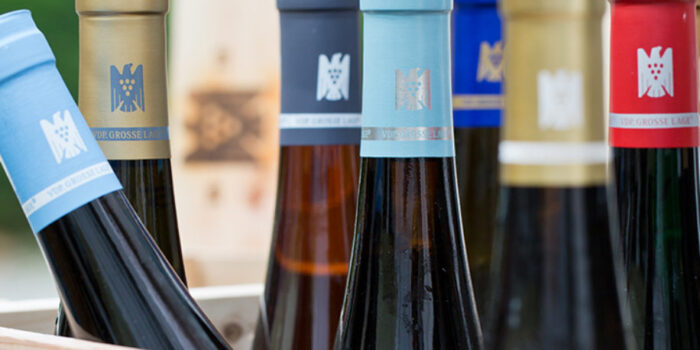
A neck label featuring an eagle with a bunch of grapes is the absolute pinnacle. This VDP classification—Gutswein, Ortswein, Erste Lage and Grosse Lage—is the ultimate mark of quality for the best German wines. It strongly resembles the system used for French Burgundy wines. The term Grosse Lage (Grosses Gewächs) is comparable to Grand Cru, and Erste Lage to Premier Cru. This Verband Deutscher Prädikatweinguter (VDP) comprises around 200 winemakers who work according to strict, voluntarily imposed quality standards. Standards that go beyond the normal rules. This is no longer mainly about dry or sweet, but about terroir. Not the sugar, but the origin, is what matters most. Just as with the French greats.
Read also:
- These are the 400 best wines under 25 euros
- 5x the best wine with duck
- 5 cheap holiday destinations for food lovers


