


Feta versus salad cheese: what is the difference?
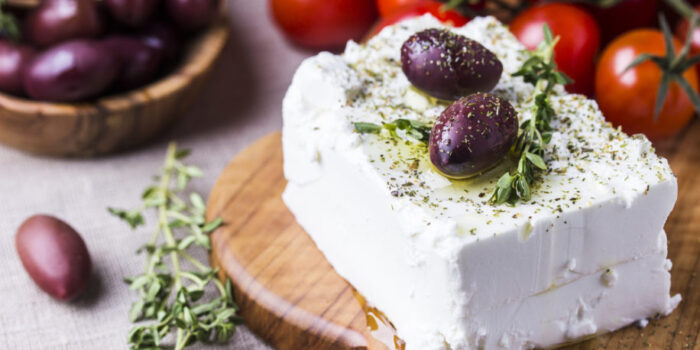
Have you ever stood in the supermarket and hesitated between a pack of feta or ‘salad cheese’? I get it, because budget-wise it makes quite a difference and they look virtually identical. So what exactly is the difference? I looked into it for you.

Feta
To start at the beginning: feta is a Greek cheese that belongs to a family of white cheeses that also includes beyaz peynir (Turkey), sirene (Bulgaria) and telemea (Romania). The cheese is made from sheep’s milk from specific regions in Greece, sometimes supplemented with goat’s milk, and salted and preserved in brine for at least two months. All of that gives it such a creamy, piquant, salty flavour. Mmmm.
Just like wine
Actually, you should think of cheese like wine: where it is made has quite an influence on the flavour. The climate, soil, breed, type of animal and what they eat all determine the final product. The Greek sheep and goats eat wild herbs, flowers and hardy grasses. This produces the thickest, most aromatic milk in the world.
‘Feta’ made from cow’s milk, such as the kind produced in Denmark (Arla Foods), is therefore also a thorn in the side of the Greeks. The cows graze there on fresh, wet grass and clover. Nothing wrong with that, but it does give the cheese a different flavour. For years, there was a dispute over whether or not to add ‘feta’ to the list of products with a Protected Designation of Origin (PDO).
European regulations
In 2002, the time had come. Since then, a cheese may only be called feta if it is produced in Greece and made from at least 70 per cent sheep’s milk and no more than 30 per cent goat’s milk. That is why Arla’s white cheese now carries the brand name Apetina and is no longer called feta.
The ‘feta decree’
In Greece, they take it one step further. In many a Greek cheese shop, you will find a sign displaying the ‘feta decree’. It is often a framed A4 sheet decorated with Greek flags, listing the fifteen commandments that feta must meet according to Greek legislation.
So is salad cheese inferior?
All well and good, all those rules, but do they say anything about quality? Well, no. Salad cheese is not necessarily of lower quality than feta, and feta is not necessarily an artisanal product. Such a PDO designation may also simply be used by large producers, as long as they meet the guidelines.
It is true, however, that some white/salad cheese made from cow’s milk is ‘bleached’ to make it look more like sheep’s or goat’s milk. And it is often pressed into a square shape to give it that characteristic form. But hey: that doesn’t mean it can’t be delicious.
As Juliet Harbutt, author of The World Cheese Book, puts it: ‘It may well taste delicious and add character to a salad or roast vegetables but it isn’t feta any more than a pinot noir from Oregon may be spectacular but it isn’t and never will be, or want to be, a burgundy.’
Read also:
- Did you know liquorice is so dangerous?
- Brioche twists with red fruit & ricotta glaze
- Why Fruit Mentos never tastes the same after playing the sweets-on-the-back-seat game
Source: RIVM


