


Fix Your Crème Brûlée
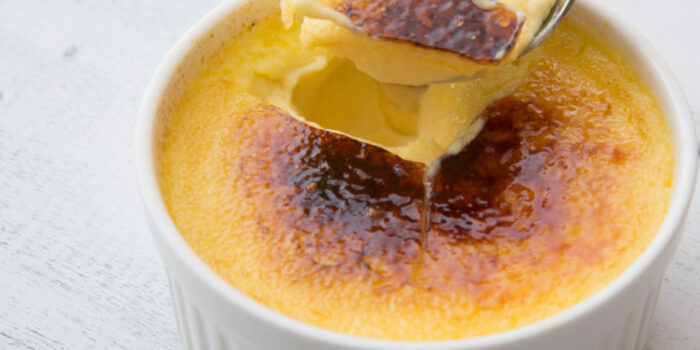
We love crème brûlée. It may well be the most delicious dessert in the world, but it has to be prepared perfectly. A completely burnt layer of sugar? An inside that’s far too jiggly? We’d rather skip it. These are the four common crème brûlée mistakes.

Crème brûlée mistakes you should stop making
Using the wrong dishes
You should always make crème brûlée in wide, flat and shallow dishes. Don’t have those? Then don’t just start using other pots, bowls or dishes. Because if they’re too deep, there’s a chance your crème brûlée will become overcooked on the outside, while the inside is nowhere near done yet. What a shame. If the dishes aren’t wide enough, you can only cover a very small surface with the sugar layer. And since that’s what makes this dessert so utterly special, we want that layer to be as large as possible.
Using a whole egg
For the custard, you only need the egg yolk. Egg white is unnecessary; it makes the dessert far too firm. We prefer a soft and creamy custard, and that’s how it should be.
Caramelizing under the grill
Have you ever bought ready-made crème brûlée at the supermarket? Then you’ll read on the packaging that you should caramelize the layer of sugar on top under the hot grill. Even if you make the dessert entirely from scratch, that is indeed an option, but take it from us: the layer will never become as perfectly crisp as it does when you use a blowtorch. It’s a win-win: you don’t have to wait forever for your brûlée to cool down again, but it creates a warm topping and lukewarm custard, ready to serve. That’s how it should be.
Choosing granulated sugar
Larousse opts for cane sugar. And although the hefty reference book is completely on its own in doing so, it is right. No, you’re better off not using white granulated sugar on top of the dessert. Why not? With granulated sugar, you have to torch it for much longer before you get a crisp, beautifully golden-brown layer. And that’s not the intention, because then your custard heats up and the layer becomes a little chewy in turn. To create the perfect sugar layer, the custard should be deliciously cold, so that the contrast with the heat of the blowtorch is as great as possible. Oh, and besides: because of the prolonged torching, the chance of a burnt taste is also much greater.
Also read:
- Recipe: Pandan crème brûlée
- 5 more things you can do with that crème brûlée blowtorch
- I have a separate stomach for dessert


