


Michelin, Gault&Millau, Bib Gourmand: what are the differences?
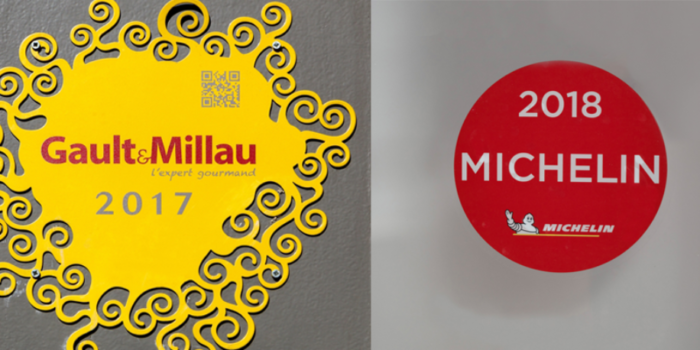
They all publish a guide and they’re all French. So far, those are the similarities between Michelin, Gault&Millau and Bib Gourmand. But what are the differences?

Michelin
The Michelin Guide is the oldest of the three (if you’d like to read something about the history of the guide, look here). It began in France in 1900 and has since grown into an annual guide for each country (the Netherlands was added in 1957).
Star system
The bright red book contains brief restaurant reviews and an extensive system of symbols, of which the stars are naturally the best known.
Criteria
Restaurants receive zero to three stars (the difference between them, read here) from independent inspectors. To ensure that independence, inspectors always dine anonymously, pay for their meal and assess restaurants according to five criteria:
- Quality of the products
- Mastery of flavor and cooking techniques
- The personality of the chef in their kitchen
- Value for money
- Consistency between visits
Forks and spoons
When awarding stars, inspectors do not look at the interior, the setting or the quality of the service. Those points are assessed separately and indicated in the guide with one (reasonably comfortable) to five forks and spoons (luxurious).
Bib Gourmand
The Bib Gourmands—derived from Bibendum, the name of the famous Michelin Man—have been part of the Michelin Guide since 1955. It is not a star, but—to quote the guide itself: “certainly not a consolation prize either.” Bib Gourmands are awarded to restaurants that offer high quality at a reasonable price. More precisely, under €36 for a three-course menu, excluding drinks.
Initially, these restaurants were marked in the guide with a red R. Since 1997, the cheerful Bib Gourmand symbol has been used instead: an image of the Michelin Man licking his lips.
A restaurant cannot have both a star and a Bib Gourmand, by the way.
Gault&Millau
The Michelin Guide’s major competitor is the Gault&Millau guide, founded by Henry Gault and Christian Millau. It began in 1969 as a magazine for Parisians featuring recommendations for the best restaurants; since 2005, the guide has also been published for the Dutch restaurant sector.
Point system
While Michelin can award only three stars, Gault&Millau uses a points system (represented by chef’s hats) of 20 points divided into five scales (a restaurant enters the guide from 10 points onward):
– 10, 11 and 12: Restaurant of a fair to interesting standard
– 13 and 14: Good, well-kept table, reliable and sometimes original
– 15 and 16: Restaurant or brasserie offering distinctive cuisine
– 17 and 18: Very fine table, memorable experiences
– 19 and 20: The undisputed top
Generally speaking, Michelin and Gault&Millau often agree about the best restaurants, although their criticism sometimes differs in substance.
Michelin vs Gault&Millau
The biggest difference between Michelin and Gault&Millau lies in the details. For example, Gault&Millau inspectors also take into account the cuissons (the cooking of meat or fish), flavor and presentation, ingredients, the welcome, wine advice, opening days and whether or not the chef is present in their assessment. They also consider attentiveness, timing, atmosphere and even the chairs. Michelin looks more at the bigger picture.
As Mac van Dinther wrote in de Volkskrant: “Stars are and remain every chef’s wildest dream. In France, Gault&Millau has also built up a reputation; in the Netherlands, the guide has not been around long enough for that yet.”


