



The ultimate truffle guide
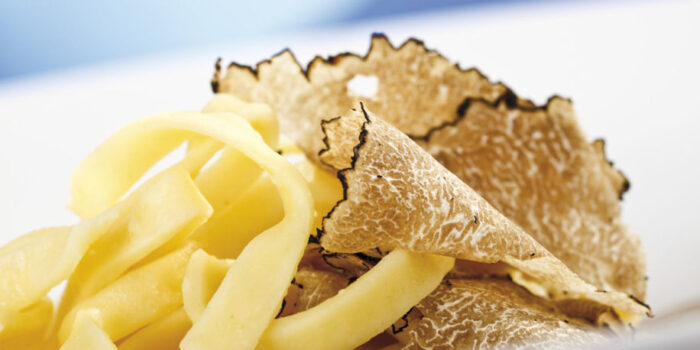
One of the most aromatic and exclusive delicacies to be found on Earth: the truffle. Where does it come from? What varieties are there, and how can you best bring out that sensational flavor? This is the ultimate guide, with everything you need to know about truffles.

Truffle hunting
The truffle is not easy to find. To be precise, a truffle is a fungus that grows underground, attached to the roots of various tree species. The tubers are equipped with a striking lure: aromatic compounds comparable to pheromones, the sex attractants of both humans and pigs. Traditionally, pigs were therefore used to search for truffles, but this carries a risk. Pigs have a tendency to eat the truffle they find immediately. This is why searching for truffles with a pig is forbidden in Italy. A more accessible way to find truffles is with a dog.
Truffle hunters in Italy are called cavatori. The most famous hunters come from the Norcia region, but there are also many in Umbria, Tuscany and Piedmont. The search for truffles is serious business, and every cavatore must have a valid permit, with very strict enforcement. There are severe penalties for illegally searching for truffles. In France, a truffle hunter is called a caveur.
Black or white
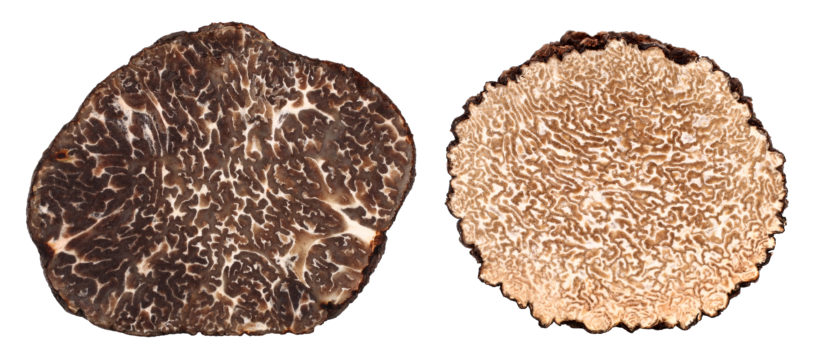
The best-known truffles can be distinguished by two colors: black and white. The most famous and most widely used truffle is the black one. This mushroom is black in color and lightly veined. Black truffles grow all over the world, but the most sought-after is still the French Périgord. You can recognize the black truffle by its earthy flavor and aroma, which come out even better when heated. The aroma is reminiscent of musk or juniper.
White truffles are much rarer, more complex, more delicate and more intense in flavor. If you are not used to the aroma, you may initially think of garlic or cooked cabbage. The white truffle is light brown on the outside and beige on the inside with white veins. And let’s not forget the difference in price. Black truffles usually cost between €600 and €1,200 per kilo. Prices for a kilo of the white variety can reach as much as €7,000. Prices naturally depend on the season, origin and size of the harvest.
Seasonal
Each season has its own truffle, of which the winter truffle is the best-known variety. It may be hunted from November 15 to March 15. They are at their best in December and January. The truffle is best enjoyed in sauces, risottos and pastas, or freshly shaved over a piece of fish or steak at the last moment.
The autumn truffle is a synonym for the notorious white truffle. The hunting season is open between October 15 and January 1. The Italians have a beautiful saying about the white truffle: ”Chi li prova, diviene il suo eterno ammiratore” — whoever tastes it becomes its eternal admirer. Because the aroma and flavor of the white truffle are so sensational, it should never be used in a sauce. Only served freshly shaved. In addition to a white truffle, autumn also brings a black truffle. Its flavor and aroma are slightly less intense than those of the summer truffle, and it works well in sauces and risotto.
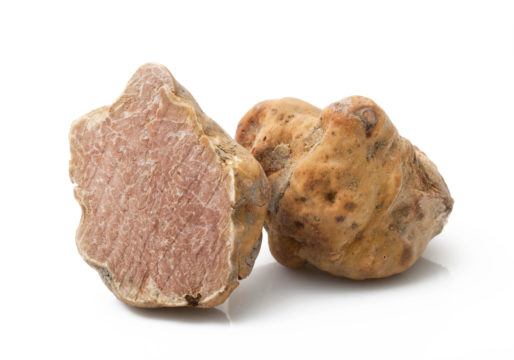
The season for hunting the summer truffle runs from May 1 to September 1. Many people think that the summer truffle is far less interesting than the winter truffle, but nothing could be further from the truth. The quality is excellent; only the flavor is somewhat less robust. The price is also considerably lower.
How to use fresh truffle
Have you acquired a fresh truffle? Handle it with care. Buy a special truffle slicer, which you can use to cut wafer-thin slices. Process your truffle in sauces, pasta and risotto, or shave it over dishes. The flavor of the black truffle comes out best when it is heated and allowed to infuse for a while. White truffles do not need to be heated. They naturally have a powerful flavor, and cooking only diminishes it.
Also delicious: shave some pieces of your truffle and let them infuse in extra virgin olive oil. Voilà, you have made your own truffle oil! Store your truffle in a sealed container in a dark place. Also add a piece of newspaper or paper towel, as this absorbs moisture. The truffle can be kept for up to two weeks.
Read also:


