


All about Indian breads
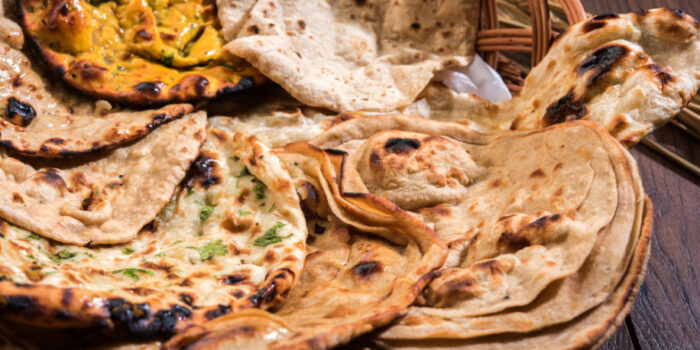
Roti, naan, paratha, puri: Indian cuisine has quite a few types of bread. Very handy for eating all those curries and delicious stews with. But what are the differences?

Roti
Wherever you go in India, north or south, you’ll find roti baked on a tawa (a flat iron griddle): a whole-wheat, unleavened flatbread.
The word roti is mainly used in the north, by the way. In the west (around Mumbai) and south of India, they call it chapati. The word chapati is a corruption of the Hindu and Urdu word for ‘slap’. Chapati is literally slapped from hand to hand to make the dough thin and round (just like pizza dough).
We mainly know roti as part of the Surinamese Hindustani chicken dish, but in India it is one of the most widely eaten breads. Because of its relatively neutral flavor, roti/chapati is mainly served with more heavily spiced curries and vegetable dishes.
https://www.instagram.com/p/BcGt3K0hWfN/?tagged=phulka
Naan
Perhaps the most familiar Indian bread (to us) is naan. Quite strange, really, because unlike roti, it is only eaten in the north of India.
Naan is baked in a tandoor: a kind of earthenware barrel that serves as an oven. The barrel (sometimes simply a hole in the ground) is heated with charcoal. The naan dough is baked against the side of the barrel. The combination of direct and indirect heat bakes the bread in just a few minutes and creates those beautiful, lightly charred air bubbles.
The bread is usually made with maida, a low-protein wheat flour that could be compared to fine white wheat flour. To give it a fuller flavor, it is mixed with milk or yogurt and water.
In the Netherlands, the choice usually remains limited to plain, butter or garlic naan, but it is also sometimes dressed up with ghee and mint. In the Punjab region, kulchas are a specialty: naan filled with paneer, potatoes, onions or meat.
https://www.instagram.com/p/BgtXlWQF05N/?utm_source=ig_embed
Paratha
Parathas are made from the same dough as roti, but instead of baking the dough dry on a tawa, it is rolled out very thin, brushed with oil or ghee, then folded and rolled out into thin layers again. A good paratha is just as flaky and layered as a croissant and—very importantly—not too greasy.
Because of the ghee/oil, paratha is less neutral than roti and is eaten more as a standalone bread. It is also sometimes filled with potato (aloo paratha) or meat and rolled up like a wrap.
https://www.instagram.com/p/BkFdUk7nElY/?tagged=paratha
Puri
Puri is made from dough without yeast or chemical leavening agents such as baking powder. Because the flatbread is deep-fried, it puffs up like a kind of beach ball.
Like roti, puri is used as a kind of spoon when eating saucy dishes such as chana masala. Sometimes (if the puri doesn’t collapse) it is filled with curries.
https://www.instagram.com/p/BkKA-t7nA0A/?tagged=puri
Pancakes!
And what about dosas, appams, idlis, pesarattu and uttapams? These aren’t breads, but different types of Indian pancakes. More on that later.
https://www.instagram.com/p/BiwYliDgZBz/?tagged=saravanabhavan
Also read:


