



Brrr… Icewine!
‘It’s a labour of love and a taste like no other.’

Making icewine isn’t for everyone. It requires patience, knowledge and perseverance. And, last but not least: a whole lot of courage. Because what winegrower is crazy enough to leave their beloved grapes hanging until they’re frozen solid? Only to then head into the vineyard in the middle of the night – at around 10 degrees below zero – to harvest them. But they do exist, and that’s why we can enjoy these liquid snow crystals. But sip it, okay!
Because grapes for icewine (or Eiswein, Icewine, depending on the country of origin) are only picked once they’re frozen. Much later than normal, because depending on the variety and region, the harvest usually begins sometime in September or October. But to make icewine, just as with kale, the frost must come first. If that night frost doesn’t arrive in time – or simply doesn’t arrive at all – there’s a chance the overripe grapes will be affected by mould or rot. And then the entire harvest is suddenly worthless. So as a winegrower, you need to have some nerve if you choose icewine. Mother Nature offers no guarantees.
Thick skin
To limit the risks, late-ripening varieties are used. They can naturally remain on the vines for a long time, reducing the chance of mould. These are usually white varieties, with the Riesling grape leading the way. It ripens late, has a slightly thicker skin (making it less vulnerable to external influences) and also has a lovely sweet-acid balance. Blue varieties are used too, but they are generally somewhat more sensitive.
But why exactly does the frost need to come?
In European wine countries, such low temperatures are rare
A drop
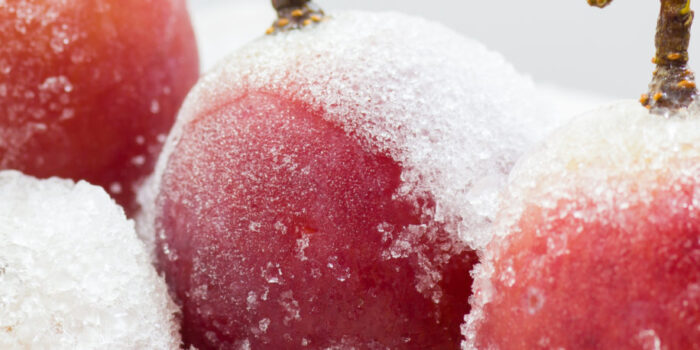
When the mercury falls below zero, the moisture in a grape freezes faster than the sugars present. If those grapes are harvested at a minimum of – 8°C and pressed immediately while still frozen, the ice crystals remain behind in the press along with the skins. The glycerine-like liquid that remains is intense and concentrated in flavour. Apparently, each frozen grape produces only one drop of icewine. You immediately understand why the bottles are so small.
The final result is a fragrant, sweet wine. But compared with other dessert wines, it still has something light-footed, something fruity, something playful. Icewine has a unique freshness, after all. With a relatively high acidity and a relatively low alcohol percentage. It’s best served well chilled; somewhere between 6°C and 8°C. Then a glass like that needs no accompaniment at all. But if you do want something to eat with it, choose foie gras, spicy Asian food, mould cheeses, crème brûlée, or something like apple pie.
Three frosty days
In countries such as Germany, Austria and the French Alsace, Eiswein has been made for centuries. It is said to have been discovered by accident. Once, a winegrower tried to salvage what could be salvaged when their harvest suddenly turned out to be frozen. The meagre yield proved to have a unique, concentrated flavour. Canadian Icewine, by contrast, has only existed since the 1970s. The production process is the same, but there are differences too. Icewine, for example, can be produced much more often than Eiswein. Good quality requires at least three frost days at – 8°C. In many places, the number of days is even legally stipulated. In European wine countries, such low temperatures are rare, meaning it is often impossible to get the grapes frozen at all. But in Ontario, Canada, that is almost never a problem.
”When mother nature grants us the harvest, we are just grateful… and start working!”
Moreover, the grapes often remain hanging there a little longer, resulting in a higher sugar content at harvest. This generally makes Icewine more opulent in flavour, with a higher alcohol percentage and somewhat lower acidity.
But whatever destination a winegrower has in mind for their grapes beforehand, in the end other forces determine whether and when they can turn their harvest into icewine. As a Canadian winegrower rightly remarked recently: ”When mother nature grants us the harvest, we are just grateful… and start working!”
Watch the impressive Eiswein harvest in 2012 at Schloss Vollrads (Rheingau).


