


Cooking at -70 degrees
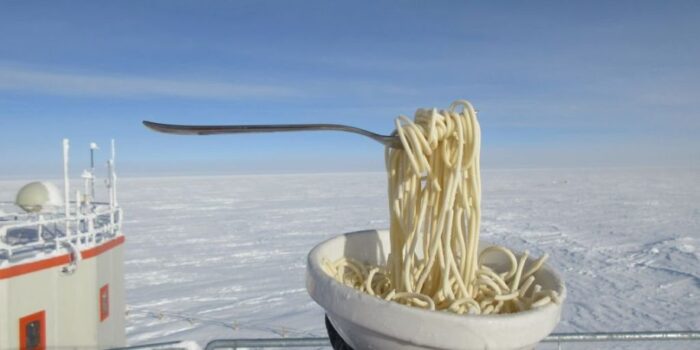
What happens when you try to cook at -70 degrees? Glacier specialist and astrobiologist Cyprien Verseux investigated.

The French scientist is currently working at Concordia Station, the most remote scientific base in the world, in Antarctica. When he is not busy with his research, he writes on his blog about the harsh conditions of his workplace. Such as what it is like to cook in temperatures like that. At least, if you were to do it outside. The result? These bizarre frozen creations:
Les températures sont remontées au-dessus des -70°C, mais il fait encore un peu frais pour manger dehors…
Crédits : Carmen Possnig et Cyprien Verseux, © @ESA / #PNRA / #IPEV #ConcordiaStation #Antarctique #DC14 @ItaliAntartide pic.twitter.com/Qe57XzDTV5
— Cyprien Verseux (@CyprienVerseux) October 1, 2018
Un petit déjeuner équilibré, sur le toit de #ConcordiaStation
Crédits : Cyprien Verseux et Carmen Possnig, © @ESA / #PNRA / #IPEV #ConcordiaStation #Antarctique #DC14 @ItaliAntartide pic.twitter.com/AvWiUBtGo4
— Cyprien Verseux (@CyprienVerseux) October 2, 2018
Tentative (ratée) d'œufs brouillés à #ConcordiaStation.
Crédits : @CPossnig et @CyprienVerseux. © #PNRA (@ItaliAntartide) / #IPEV / @esa#Antarctique #DC14 pic.twitter.com/eJbBhKEz40
— Cyprien Verseux (@CyprienVerseux) October 3, 2018
Nutellart, ou : même le goûter n'est pas évident à prendre sur le toit de #ConcordiaStation.
Crédits : @CPossnig et @CyprienVerseux. © #PNRA (@ItaliAntartide)/#IPEV/@esa#Antarctique #DC14 @NutellaFR pic.twitter.com/QB5xt1Avo5
— Cyprien Verseux (@CyprienVerseux) October 4, 2018
Raclette à #ConcordiaStation.
Crédits : @CPossnig et @CyprienVerseux.
© #PNRA – @ItaliAntartide / #IPEV / @esa@ItaliAntartide#DC14 #Antarctique pic.twitter.com/WdC4nj0dDg— Cyprien Verseux (@CyprienVerseux) October 7, 2018


