


DWDD cooks: COULIBIAC AU SAUMON
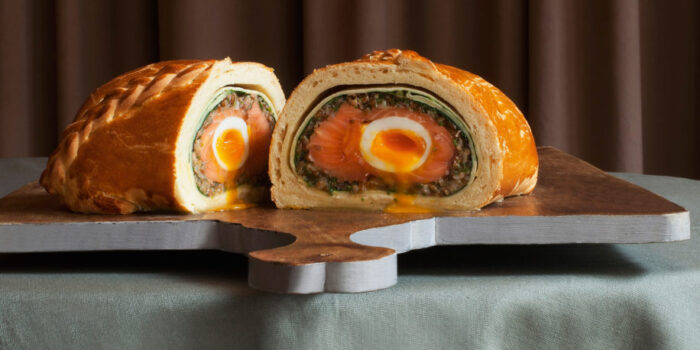
Pies…in Russia they have developed into a national dish, and there are many hundreds of varieties of pirog, as the Russians call a pie. One such variety is kulebjaka, considered the pièce de résistance among pirogi. It was culinary grand master August Escoffier (1846-1935) who brought the salmon version to the West. In French, the dish was called coulibiac, and it grew into one of the most impressive dishes in French cuisine. The Russian exhibition Dining With The Tsars at the Amsterdam Hermitage prompted the request for Joris Bijdendijk to make his own version of coulibiac au saumon.

Brioche dough
Making brioche dough is quite an art and also time-consuming; take the time to learn about it! Mix the eggs, sugar, yeast and milk in the food processor with the paddle attachment at medium speed for approximately 2 minutes. Add the flour little by little and mix for another 2 minutes. Replace the paddle attachment with the dough hook and mix for another 10 minutes. Add the salt, followed little by little by the butter. Once all the butter has been incorporated, continue mixing at low speed for 15 minutes, until the dough acquires a satin sheen. Transfer it to a tray and cover with plastic wrap. Leave to rise at room temperature for 1 hour. For an optimal result: punch down the dough and leave to rest in the refrigerator for 16 hours. Roll out the dough on a floured work surface into a 35 x 35 cm sheet, 6 mm thick; cover with plastic wrap and keep chilled.
Crêpe batter
Mix the eggs, milk, flour and cornstarch and leave to rest for 1 hour. Spread onto a greased baking tray into a 35 x 35 cm square and cook in the oven at 100 °C. Leave to cool. Cover with baking paper cut to size and turn the baking tray over so that the paper is underneath.
Boil the 5 eggs in boiling water for 7 minutes, then rinse under cold water and peel them (the yolk should still be just runny).
Cut the finest 25 cm from the center of the side of salmon; the head and tail sections will be used for the tartare. Starting from the center, cut lengthwise through the thick section to within 2 cm of the back; open it up so that you have one large slice of salmon, and spread it out on plastic wrap.
Salmon tartare
Chop the remaining salmon into small pieces and keep in a bowl on ice. Season the tartare with salt and pepper. Grate bottarga to taste and season the salmon tartare with it. Grate the green part of the lime zest and season the tartare with it. Finely chop the chervil, tarragon and chives and add 2 tablespoons of each herb. Carefully mix all the ingredients with a spatula and leave the tartare to rest briefly in the refrigerator before use.
Peel the 5 boiled eggs and place them one behind the other in the opened salmon. Fill the remaining hollows with the salmon tartare and close the salmon, overlapping it slightly. Wrap it in plastic wrap like a sausage and keep refrigerated.
Blanch the Swiss chard leaves in salted water, then cool them in ice water and pat dry with paper towels. Lay each piece out on a 35 x 35 cm piece of plastic wrap.
Saint John’s rye
Prepare the Saint John’s rye like pilaf rice: heat the butter in a heavy-based pan. Add the Saint John’s rye to the pan all at once and heat, stirring with a wooden spoon, until all the rye is coated with butter. Finely slice the onion and add it to the Saint John’s rye together with the garlic and white wine. Cook until dry, then add the vegetable stock and thyme. Season with pepper and salt and bring to a boil, stirring. Cover with baking paper cut to the size of the pan (cartouche) and cook over low heat for 15-20 minutes. Once properly cooked, transfer to a dish and leave to cool.
Mix the egg with the milk and whisk briefly to loosen.
Assembly
Place the crêpe on baking paper on the work surface. Place the dry blanched Swiss chard leaves on top, exactly to size. Divide the Saint John’s rye over them. Place the fresh salmon roll with the boiled eggs on top (without the plastic wrap) and make one large roll by carefully rolling the baking paper around the four layers.
Place the whole thing at the beginning of the rolled-out brioche dough. Carefully roll the filling out of the baking paper, with the overlapping side facing up, and roll it in the dough until it is enclosed, but now with the overlapping side facing down. Cut to size and decorate with puff pastry motifs if desired.
Brush the inside edges with the milk-and-egg mixture and press them together. Cut off and remove the excess dough. Leave the dough to rise on a baking tray lined with baking paper at room temperature until it has approximately doubled in size (this takes about 2 hours).
Now also brush the coulibiac with the milk-and-egg mixture and bake for 20 minutes in an oven preheated to 175 °C. Lower the oven temperature to 115 °C and bake for another 20-30 minutes until golden brown. Transfer it with the help of the baking paper to a wooden cutting board and leave to rest for 10 minutes. Cut into 2.5 cm slices and serve with sour cream and caviar or horseradish sauce.
DWDD cooks with Kranenborg
Robert Kranenborg
€24.99
Kosmos Uitgevers


