


Everything you need to really cook Chinese food
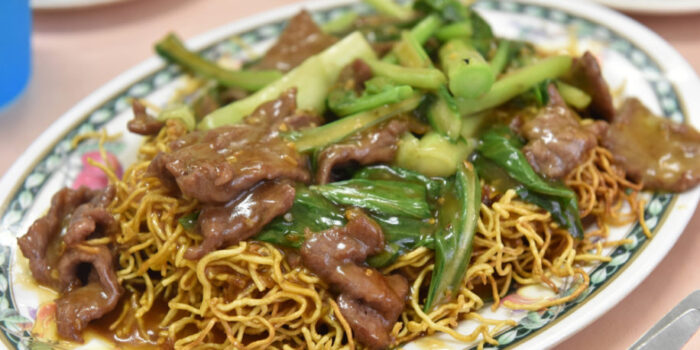
If you often visit FavorFlav, you won’t have missed it: I love Chinese food. And yes, that includes babi pangang, but above all, authentic Chinese cuisine. With these handy tools and ingredients, you’ll soon have that cuisine mastered.

Saying ‘Chinese cuisine’ is actually nonsense. It’s the same as talking about European cuisine: it makes no sense because the food is different everywhere. The best-known cuisine is Cantonese cuisine, because the Chinese people who started restaurants here mainly came from Guangdong province (Canton).
In recent years, the spicy cuisine from Sichuan province has also become increasingly popular. In western China, there is also Muslim Chinese cuisine, which uses a lot of lamb and cumin, and then there’s Hakka cuisine, Shandong cuisine and I could go on for a while. What you use partly depends on the region you’re cooking from, but in principle, these ingredients and tools will get you a long way.
Wok
Let’s start with the kitchen essentials: without a wok, you’re nowhere. And I don’t mean one with a non-stick coating from IKEA, but a real steel wok. You can buy one for as little as twenty euros at an Asian supermarket. Don’t invest in anything more expensive; they don’t use expensive pans at street markets in Asia either.
Steamer basket
Dumplings, aubergine, steamed eggs as soft as custard or whole fish with ginger, spring onion and soy sauce. For all these Chinese delights, you really need a steamer basket. I have a large two-tier aluminium steamer, but bamboo baskets in any size are also great.
Cleaver
It may sound a little scary, but Chinese people use a cleaver for everything. Whether they’re chopping a chicken into pieces or peeling an apple: a large cleaver is the way to go. If you don’t feel entirely comfortable with such a large tool, you have my permission to skip this one. Convinced already? Kiwi makes good, affordable cleavers; you can buy them here.
Chopsticks
Of course, you use chopsticks once your Chinese meal is ready, but they’re also useful while cooking. For stirring, mixing or fishing things out of the pan. Just make sure your chopstick skills are on fleek first, and then you can basically use them for anything.
Soy sauce
Cooking Chinese food without soy sauce is an impossible task. Almost every dish includes a splash of it. By the way, do you know the difference between light and dark soy sauce? You probably already have light soy sauce in your cupboard; it’s also what you eat with sushi. Dark soy sauce is less salty and milder in flavour, and is mainly used to give dishes colour. Get a bottle of each.
Shaoxing rice wine
If there’s one ingredient that instantly makes any dish taste Chinese, it’s Shaoxing rice wine. This rice wine is slightly reminiscent of sherry and is delicious in eggs, in your fried rice or as a marinade for chicken with some cornstarch, soy sauce and sesame oil.
Sesame oil
You absolutely need to get sesame oil too. A few drops add so much flavour to your dish. Check the ingredients list on the back carefully. Many varieties are actually cheap oil with added sesame flavour; choose a brand that uses 100 per cent sesame oil.
Black vinegar
One of my favourite ingredients, but perhaps also the most distinctive. The flavour of black vinegar is quite dark and intense, but once you get used to it, it makes a wonderful dipping sauce for dumplings. It’s also great for seasoning other sauces or dishes.
Oyster sauce
Of course, you can’t make the Chinese classic beef with broccoli and oyster sauce without the best-quality oyster sauce. I always have Lee Kum Kee’s premium version; did you know they invented oyster sauce? It’s also delicious in (dipping) sauces and other stir-fries.
Hoisin sauce
On your Peking duck pancake, in your bao bun, on your rice or straight from the jar. Hoisin has a very strong flavour and is particularly good eaten on its own as a sauce. Of course, you can also add it to marinades and sauces, but it’s already delicious by itself.
Dried shiitake
They stay good forever, so there’s no harm in stocking up. Dried mushrooms, especially shiitake, are used to make stock but also to add flavour to sauces. Or soak them in warm water until soft again and mix them into your omelette or stir-fry.
Star anise
Perhaps not the first ingredient you’d expect in Chinese cuisine, but star anise is used an awful lot. Simmering one or two stars in your sauce, stock or stew adds a subtle flavour that is typically Chinese.
Five-spice powder
This is a useful one if you don’t feel like buying everything else. Chinese five-spice powder is a blend of cinnamon, star anise, Sichuan pepper, fennel and cloves, and gives dishes—especially meat dishes—a distinctive flavour. The great thing is that you often don’t need anything else. For example, mix chicken wings with five-spice powder and some salt, roast them in the oven and you’ll have a delicious dish.
Fermented black beans
These aren’t the black beans you know from a tin, but small, dry and very salty beans. A must for chicken with black bean sauce, but also for Sichuanese mapo tofu. The beans add plenty of salt as well as umami to a dish. Always rinse them before using, then chop them finely and add them to the dish.
Sichuan peppercorns
I buy these in large bags because Sichuanese cuisine is my favourite, and this ‘peppercorn’ appears in almost every dish from that region. They aren’t real peppercorns; they look more like little flowers. They have a slightly anise-like flavour and a numbing heat when you bite into one.
Doubanjiang
If you also love Sichuanese cuisine, make sure you stock up on doubanjiang chilli paste. The fiery red paste is the basis for spicy aubergine, mapo tofu or fish in spicy sauce. A few tablespoons add a great deal of heat and even more flavour.
Read also:


