


Food guide: Tuscany
Italy is the land of endlessly delicious food and drink, which is why we love coming here so much. Every region, area and even city has its own local specialties and delicacies. We are travelling to the region of beautiful landscapes, picturesque villages and fantastic food: Tuscany.

Acquacotta
Acquacotta comes from Maremma, one of the southernmost areas of Tuscany. The literal translation of acquacotta is ‘a bowl full of boiled water’. It is the result of la cucina poverva — the cuisine of the poor. In the past, the inhabitants of Maremma had to make do with what the land provided: a handful of onions, some tomatoes, a few carrots and celery. These ingredients were thrown into a pan of water, creating a kind of vegetable soup. Today, the soup is one of the best-known dishes in the region and certainly no longer food for the poor alone.
Pappa al pomodoro
There are four ingredients Italians always have at home: tomatoes, bread, olive oil and basil. These exact ingredients form the basis of pappa al pomodoro, literally translated as tomato mush. Eat it as an antipasto or as a main course, together with a slice of fresh Tuscan bread.
Pici
Outside Tuscany, you will not find this pasta anywhere. It looks like spaghetti, but is much thicker. The preparation of pici is simple: thick strands are rolled by hand from flour, water, olive oil and a little salt.
https://www.instagram.com/p/BfgXNLLgQZZ/?taken-by=noe.food
Ribollita
Ribollita is made with vegetables and stale bread and, like acquacotta, originated as a dish for the poor. Its origins lie in the Middle Ages, when a large part of the population had little to eat. Instead of throwing products away, they were made into soup. You make ribollita a day before eating it and cook it a second time before serving. As with many other dishes, the flavour is even better then. What goes into it? Basically all kinds of vegetables that grow in Tuscany. Think onions, celery, carrots, potatoes, cabbage, tomatoes and cannellini beans.
Trippa or lampredotto
If you walk through the centre of a Tuscan city, you cannot miss them: the small kiosks where the trippaio or lampredottaio sells a trippa or lampredotto sandwich. Meat made from one of the cow’s four stomachs. In Florence, the sandwich is considered a traditional local dish. Every trippaio or lampredottaio has their own preparation method, but the oldest is al naturale. In this version, the stomachs are boiled in stock and seasoned with salt and pepper.
https://www.instagram.com/p/BjcmOzsAu-6/?tagged=trippaio
Crostini al Fegatini
A typical Tuscan antipasto: spreadable pâté made from chicken liver, olive oil and capers. It is served on a crostini made from typical Tuscan bread: filone.
Panzanella
Panzanella is so simple, yet still one of our favourite dishes from Tuscan cuisine. The base consists of stale bread soaked in water with a dressing of vinegar and oil. Ingredients such as cucumber, tomatoes and red onion are added.
https://www.instagram.com/p/Bj8k-4AAcPN/?taken-by=laurenkandelc
Fagioli al fiasco
Tuscans are often called bean eaters by Italians from other regions. Fagioli al fiasco includes beans, oil, chives, sage and peppercorns, among other ingredients. In the past, Tuscan farmers put their beans in a large pot or bottle beside a fire. They left them there overnight so that they could eat freshly cooked, warm beans for breakfast the next morning.
https://www.instagram.com/p/Bf7kkxoHycy/?tagged=fagiolialfiasco
Trippa alla Fiorentina & zampa alla Parmigiana
Trippa—beef tripe, that is. Trippa alla Fiorentina is slowly cooked until tender in a sauce of tomato, butter, Parmesan, pepper and salt. Another unusual part of the cow that is widely eaten is zampa alla parmigiana—cow’s foot slowly braised for a long time.
Bistecca alla Fiorentina
Italians call this steak fiorentina; we call it a T-bone steak. Whatever you call it, it is a large cut of meat, with sirloin on one side and tenderloin on the other. It is surrounded by fat, which keeps the meat juicy during grilling. Traditionally, the meat is grilled over an open fire. Nowadays, it is grilled briefly and served on wooden boards with grooves to catch the meat juices.
https://www.instagram.com/p/BK-_GorDDrQ/?tagged=bisteccaallafiorentina
Farinata- & torta di ceci
Ceci is Italian for chickpeas. A farinata is a thin, crispy pancake, while a torta is the thicker, bread-like version. For the best torta di ceci in Livorno, go to Gagarin, just outside the central market. It is one of the last remaining torterie, where they have served nothing but torta for 53 years.
Portato tortelli
The name says it all: tortelli filled with portato, parsley, garlic and Parmesan. Italian families mainly make this dish in spring and summer.
Castagnaccio
Many chestnut trees grow in northern Tuscany. When wheat flour was scarce, chestnuts were dried and ground as a substitute. Chestnut flour is used to make castagnaccio, a traditional flat cake decorated with pine nuts and rosemary.
Cantuccini
They are also known as biscotti di Prato, named after the city neighbouring Florence. You probably know them: those incredibly hard yet delicious almond biscuits. They are baked twice, which is why they are so hard. Eat cantuccini as the traditional ending to a Tuscan dinner and dip them in the sweet dessert wine of the saints: Vin Santo.
https://www.instagram.com/p/Bd_JCMrhEPX/?tagged=cantuccini
Panforte
The Tuscan city of Siena is known for panforte, which literally means firm bread. Panforte is a cake flavoured with a mixture of cinnamon, coriander, cloves, nutmeg, allspice and star anise.
Ricciarelli
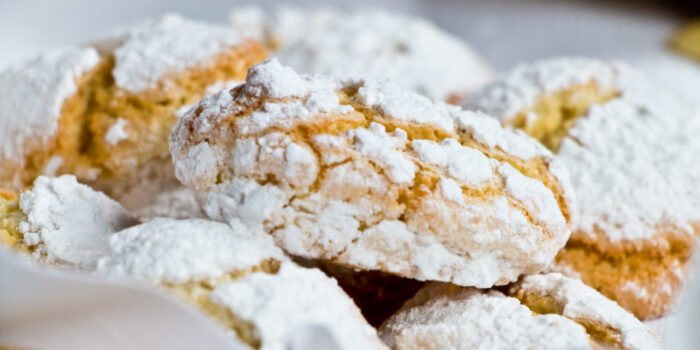
Ricciarelli are made from almond paste, sugar and egg white, and flavoured with extra candied orange peel. They are oval, have rounded corners and are characteristic of Siena.


