


Foodlingo: Bao(zi)
Food editor at large Marjan Ippel regularly introduces a new or recently reintroduced term from the food scene here, the so-called foodlingo. No foodie can do without it. After all, ‘what (not) to speak’ is at least as important in food as ‘what (not) to eat’.

This time: bao(zi)
Short version
Chinese steamed bun filled with meat, vegetables or both. From pork to red bean paste.
Longer version
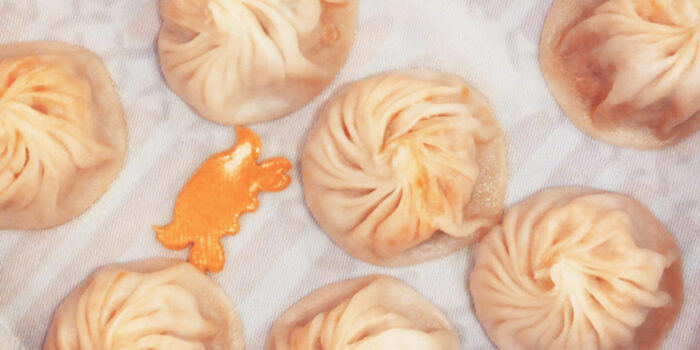
There are quite a few varieties, both in China and elsewhere. And sometimes they seem to have hardly anything to do with one another at first glance. From the small, refined types of dumpling such as the xiao long bao popular in Shanghai (soup dumpling; see photo), made from an ingeniously knotted, pasta-like sheet of dough with filling, to the larger cha siu bao.
Never miss another foodlingo term? Follow us on Facebook.
Mantou
The latter is made using mantou, a bun made from steamed rather than baked wheat dough, which makes it cloud-light and soft without a crust.
The Cantonese pulled pork sandwich cha siu bao was first sold as a snack in the teahouses of Guangzhou. Because it is easy to handle and not very messy, the steamed dough ball with filling is now often eaten on the go. This is in contrast to the much smaller dumpling, which you have to fish out of the bamboo steamer basket with chopsticks at the table.
The Taiwanese gua bao envelops its pork filling like a baseball glove.
The Taiwanese gua bao is in turn similar to the cha siu bao, except that the open bun envelops its filling of slices of braised pork like a baseball glove. And yet all these varieties fall under the same heading of bao(zi). Provided they are steamed.
Gua bao
It is this gua bao that, under the name ‘steamed (pork) bun’, has conquered the entire world with great success and become a symbol of every foodie gathering, from food (truck) festivals to food halls. Thanks to Asian-American chef David Chang and his global Momofuku restaurant chain.
The legend
There is no Chinese food that does not have an origin legend in which valiant warlords and/or emperors, plus the great outdoors (especially water), play the leading roles. According to one such legend, bao(zi) were invented 1,800 years ago by military commander Zhuge Liang of the Three Kingdoms.
According to the story, he and his troops came upon a raging river whose angry spirit could be appeased only with the heads of 49 warriors. Liang did not want to sacrifice his men, so he had them make a meat filling with a layer of dough around it shaped like a head. These were steamed and sacrificed to the river spirit. The water calmed down, and the warriors were able to cross without difficulty.
(Chinese) supermarket
These days, you no longer have to go to such lengths to get your hands on a bao(zi). You can even simply buy the legendary steamed buns in any (Chinese) supermarket.
Text: Marjan Ippel
Image: Marjan Ippel


