


Foodlingo: Poké
Regularly, food editor at large Marjan Ippel introduces a new or recently re-entered term in the food scene here, the so-called foodlingo. No foodie can do without it. After all, ‘what (not) to speak’ is at least as important in food as ‘what (not) to eat’.

This time: Poké
Poké is by far the word of the week in America. All the offline and online media, from The New York Times to Eater, enthusiastically turned their attention over the past few days to the traditional Hawaiian ‘salad’ of sliced raw fish.
Dishes are hyped in the States more often, of course. Like céviche a few years ago, the raw fish from Peru cooked in citrus juice. As The New Sushi, the dish stormed the fast-casual sector.
There. Not here.
Five years
Here, céviche took quite a long time to become—and still hasn’t become—that ‘sushi’ it has by now become in trend cities such as New York and Los Angeles. But poké—Hawaiian for ‘cutting crosswise’—might well move faster.
Food trends and hype are also being picked up increasingly quickly here. Five years ago, it still took about five years for a trend or trend dish to catch on here; by now, that has sometimes been reduced to just a few months.
Poké from Hawaii originally consists of raw fish, salt, local seaweed and chopped roasted kukui nuts
The Hawaiian raw fish, originally prepared with sea salt, local seaweed (including the red limu kohu) and chopped roasted kukui nuts, may therefore quickly break through on a broad scale. What helps are the links with dishes we already know and love. Such as céviche (indeed) and sashimi (Japanese raw fish).
But it surely won’t happen at the pace at which poké travelled from the American West Coast to the East Coast. The provisional highlight was this week’s opening of New York’s first poké chain, Wisefish Poké, which the media simply couldn’t stop writing about.
Poké Bowl
Spicy ahi (with spicy mayo) and shoyu (with soy sauce) are currently the most popular poké varieties in Hawaii itself. Alongside limu/Hawaii-style poké, the only option that still actually contains the traditional kukui nuts and limu kohu.
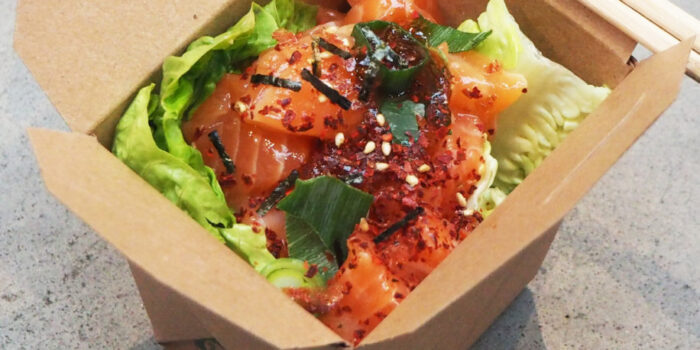
American chain poké usually concerns a so-called ‘poké bowl’: a bowl with cubes of raw tuna, soy sauce, sesame oil and rice. Familiar Japanese ingredients intended to make the transition to the less familiar Hawaiian dish easier. Not such a strange choice in itself, since Hawaiian cuisine draws heavily on Japanese cuisine.
Temaki
Here, poké has by now also entered the country via the Japanese route. Namely through the hip snack temaki—the seaweed sheet rolled like a cone-shaped fry bag, filled with fish, rice and sauce. In Deventer and Amsterdam, Meneer Temaki rolls a salmon poké temaki, filled with raw salmon marinated in the poké style and rice. Japan meets Hawaii squared, so to speak.
Thanks to Japanese connections of yet another kind, the name ‘poké’ will at least have no trouble embedding itself in our collective memory. How long will it be before a Pokémon variant appears somewhere on the poké menu?
Be an early adopter with Meneer Temaki’s poké recipe.
Text: Marjan Ippel
Image: Marjan Ippel, with thanks to Meneer Temaki


