


Get it: black vinegar
We’ve had enough of white wine vinegar, balsamic vinegar and plain white vinegar. They’re all delicious, but it’s really high time you got a bottle of black vinegar at home.

The first time I tasted black vinegar was in China, where it was served as a dipping sauce with dumplings. I had no idea what was happening to me—it was so delicious! My Mandarin is very poor—although I’m very proud of the fact that I can order two beers—but I couldn’t ask what it was, so I kept thinking about the mysterious dark sauce. So you can imagine how happy I was when it later suddenly appeared on the table as a dipping sauce at a Chinese friend’s house.
Distinctive flavour
Apparently, every Chinese person has a bottle of the stuff at home as standard. It is also called Chinkiang vinegar, after the place it comes from (near Shanghai). It has a very distinctive flavour. With most types of vinegar, you mainly taste acidity, but black vinegar tastes very earthy, umami-rich and almost smoky. You may need a little time to get used to the flavour, but believe me, you’ll soon be won over. Black vinegar is a wonderful addition to all kinds of (Chinese) dishes.
From aubergine to noodles
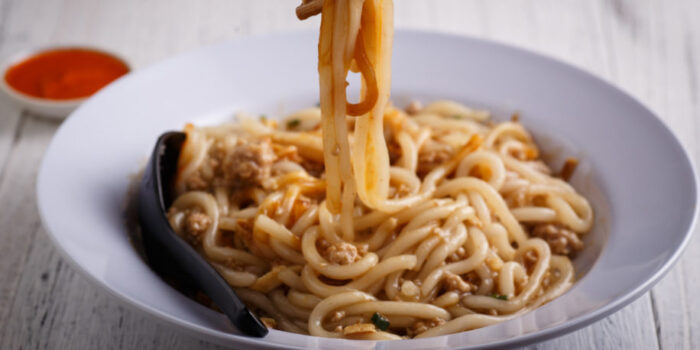
I often use it as a dip for dumplings, usually with a small spoonful of crunchy chilli oil stirred in. Sometimes with oyster sauce, soy sauce, chilli oil and toasted sesame seeds, as in this recipe. But you can also use it in stews, sauces and noodle dishes. For example, make aubergine with black vinegar, pork with black vinegar or cold noodles with black vinegar and sesame sauce. Or use it instead of balsamic vinegar in your salad dressing. Just make sure you always buy the large bottle with the yellow label (this one); I once bought a different one and it was really not tasty.


