



Hospitality entrepreneurs on their first days back open (part 2)
Monday was the day: the hospitality industry was allowed to reopen. Celebration! But was it for hospitality entrepreneurs too? How did they experience these first days back open? Did the places fill up or did they remain eerily empty? How does it feel to run a ‘1.5-metre hospitality venue’? And what were their guests’ reactions?

I asked seven different hospitality entrepreneurs: Riad Farhat (including Maxwell, Waterkant and Pacific, Amsterdam), Maarten Melo (Piet de Gruyter, Amsterdam), Vivian den Hollander (Viviamo, Woerden), Tess Posthumus (Flying Dutchmen Cocktails, Amsterdam), Ron Simpson (The Avocado Show, Amsterdam) and Boris Liesveld (Spaghetteria, Amsterdam and Utrecht).
Is running a 1.5-metre hospitality venue manageable or disappointing?
Riad: “A disaster. Financially, this is going to be a very difficult period. You can accommodate far fewer guests, but you still need a lot of staff: for the health checks at the door, for example; some businesses have multiple doors. You simply won’t make your usual turnover. I’m hoping to break even, but even that will be difficult.”
Maarten: “These first few days have gone incredibly well. I already knew beforehand what I would and wouldn’t allow. For example, if people cycle past, see their friends on the terrace, lock up their bikes and join them, that isn’t allowed. Four people you know aren’t family? They can’t sit at one table. A few guests called us the teacher’s pet, which is fine by me. It’s only good if people know they can have a quiet drink here and that everything is under control.”
Vivian: “It’s going better than expected. As a hostess, I was briefly afraid that it would all feel very negative. But everyone is understanding and considerate of one another. The atmosphere is good. What is naturally difficult is that you can’t fill all the tables optimally, and that simply hurts your wallet. Your restaurant wasn’t built for this, so that is very disappointing and genuinely difficult.”
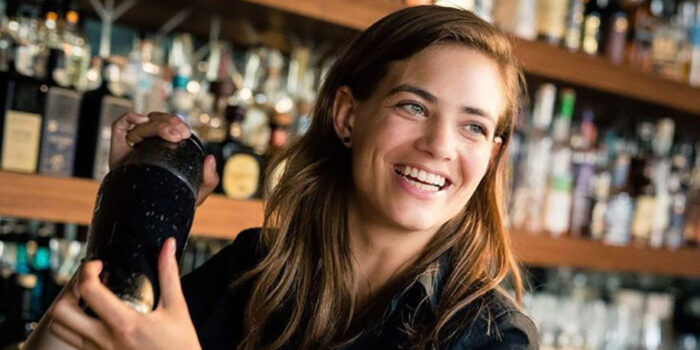
Tess: “For now, it’s manageable because there’s no one here. People may still find a bar a little more intimidating than a restaurant, but we’re doing everything very properly. If people find their way back to the bar and it gets too busy, we have a good plan for that.”
Ron: “In terms of execution, it’s manageable, but it will always be disappointing. In terms of layout, atmosphere, turnover and ten other things.”
Boris: “Arranging the seating was no fun. We work with large communal tables seating between 14 and 18 people. It’s not possible for us to separate them into individual tables, but we’ve managed to make something nice of it, and you notice that everyone is taking responsibility as well as they can.”
How did the reservations go? Did it fill up immediately or not? And why?
Maarten: “Half an hour before opening, I did find it exciting for a moment. We don’t normally take reservations, but now we had a lot of them. Would it work out? We’re really a neighbourhood café where everyone simply walks in. I was afraid the spontaneity would disappear, but it went very well. Everyone who stopped by could get a table. Sometimes not immediately, but then we did it New York-style: wrote down their number and called as soon as a spot became available.”
Vivian: “On the first day, the reservations came flooding in and I was briefly afraid we wouldn’t be able to handle it. But then it went quiet. We’ve now been open for four days and there is definitely interest, but it’s not as though people are queuing at the door. People are still waiting to see what happens. I don’t know exactly what they’re waiting for, especially when you see how carefully the hospitality industry is handling it. I wonder: why do people go to the DIY store or the market? I expected people to be queuing and celebrating the fact that they were allowed to visit hospitality venues again. But perhaps that will still happen this weekend.”
Tess: “No one yet understands that you can just drop by and make a reservation at the door. And although we did receive some advance reservations, it’s certainly not exactly packed. Through our website, you can book a table for two and immediately pay for four cocktails. We really can’t afford no-shows at the moment.”
Ron: “It went okay—not immediately packed, and partly unclear because of the rules for the terrace. People still need to get used to it; the spontaneity is the best part.”
Boris: “It took a little while to get going; no one is used to making reservations with us at all. But on the days themselves, including reservations made at the door, we get fairly full. We’re still experimenting with how best to arrange the shifts so we can spread out the peak moments more effectively.”
How big is the difference compared with pre-corona?
Maarten: “The past few days felt just like old times. Much more than I expected. But that was also because it was outdoors. I wonder how many people feel like sitting inside a pub. Do people already want to seek that out? Moreover, indoors we’ll have to enforce a door policy, which we’ve never done before. I’m curious what that will do to the energy—whether it will become stuffy or flat. More than ever, we have to create a distinctive atmosphere through good service, conviviality and music.
Vivian: “The difference is enormous. It was much more intimate: couples going out for a romantic meal, friends hugging. Everything is more structured now. That carefree feeling after a bottle of wine is gone. It’s a shame, because that’s also the charm of the hospitality industry. But perhaps it will return once everyone is a little more used to things.”
Tess: “Huge. Despite UberEats, Deliveroo, the packages and the reopened venue, we’re not even doing 10% of our normal turnover.”
Ron: “Of course it’s completely different. We all need to build it back up calmly. Being together, joining in spontaneously, being uninhibited. You can still have a fantastic evening with really good food and delicious drinks, but you do have to take certain rules into account.”
Boris: “Enormous.”
What were the guests’ reactions? What was the nicest thing to hear?
Riad: “Our guests are fantastic; they are really there for us. Including the people in vulnerable groups who therefore can’t come by. We’re receiving a great deal of support. Every day. Nevertheless, it’s still only a third of what it was.”
Maarten: “‘We missed you!’ So heartfelt and sincere—people are incredibly grateful.”
Vivian: “Guests who called to make reservations during the press conference! Saying, ‘Hey, we’re allowed to come again!’ And I said, ‘Well, it’s five past seven; we still have to watch the press conference.’ Haha. And guests who came in all dressed up on that first day, so happy for us that we were allowed to reopen. Those were very warm, sweet and lovely reactions.”
Tess: “A few genuine cocktail lovers immediately reserved for several days, which is really cool. But perhaps the nicest thing was the gift from our team: before we started on Monday, we had a team meeting and they gave us two shirts with something we always say on them: ‘Shot? Genever!’ And our emblem on the front, along with ‘Best Boss’.”
Ron: “The nicest reactions were actually that they thought we had everything very well organised in terms of safety and hygiene, but also that they had really missed us and were craving our food.”
Boris: “Reactions like ‘We were craving Spaghetteria’ and ‘It immediately feels like home again’ are pure gold.”
Read also:


