


How to: deep-fry without a deep fryer
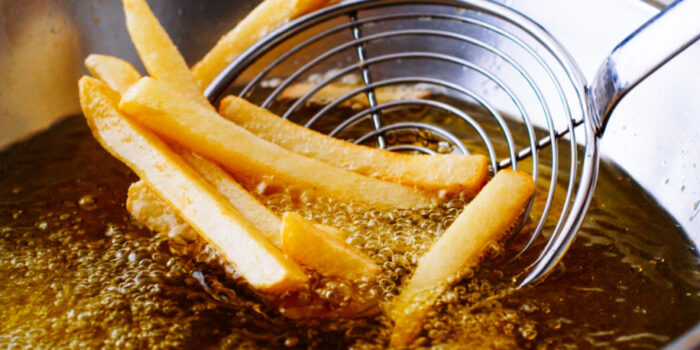
A bitterball, risotto ball, perfect fries or (Korean) fried chicken: they all taste best straight from the frying oil, but what if you don’t have a deep fryer? No need to panic—put a pan of oil on the stove and get frying.

I had a deep fryer for years. It stood on the balcony, so every time I needed it I had to go outside, and changing the oil was a terrible job. It was also completely greasy on the outside—you know, that stubborn grease that is impossible to clean off. When I moved, the thing annoyed me so much that I simply put it out with the trash. And you know what? Deep-frying is just as easy, perhaps even easier. Will you join me?
What kind of pan?
When choosing a pan, you need to pay attention to two properties: the pan must be deep and retain heat well. The pan needs to be deep because it must hold a thick layer of oil, and your food still needs to fit in it. Everything will simmer and splatter, and you don’t want the pan to overflow with boiling-hot oil. Duh.
For deep-frying, it is important that the oil is at the right temperature. A cast-iron pan retains heat well, even when cold ingredients go into the oil. A non-stick pan retains heat much less effectively, which causes the temperature to fluctuate more.
Whatever you do: make sure the pan is stable on the stove. A metal wok is widely used for deep-frying in Asia, but if your Western stove doesn’t have a special wok burner on which that enormous round thing stays properly in place: don’t do it!
Thermometer?
The biggest advantage of a deep fryer: you set it to a certain temperature and the light turns green when it has reached it. Easy as pie. So if you deep-fry a lot, I definitely recommend buying a thermometer. It costs ten euros and you can also use it when making custard or ice cream, tempering chocolate, baking bread or measuring the internal temperature of meat. Once you have one, you’ll use it for everything.
That doesn’t mean it is essential. You can also measure the temperature of the oil in other ways. Drop a piece of bread measuring approx. 3×3 cm into the oil. If it turns nicely brown within 60 seconds, the oil is approximately 185 ºC.
No bread in the house but do have wooden chopsticks? Hold them in the oil for a moment; if the oil starts to bubble, it is hot enough for deep-frying. If the oil bubbles extremely vigorously, it may be too hot.
Other tools?
The only other tool you need is something to fish your freshly fried goodies out of the oil. A slotted spoon works best for this, but if you’re frying larger things such as chicken legs, you can also use kitchen tongs. A cooling rack is handy for letting things drain, but you can manage perfectly well without one.
How much oil?
The danger of deep-frying in a pan is that, for convenience, you add too little oil. A few centimeters should be enough, right? Sometimes yes, but sometimes definitely not. With something like tempeh, tofu or eggplant, that is fine. While frying, you can toss them around a little and make sure they turn brown on all sides.
So when do you need to completely submerge something in oil? When you’re dealing with things that fall apart if you toss them around or things that are likely to stick to the bottom of the pan. Indonesian corn fritters? Fry those in at least a liter of oil. Tempura? You also use plenty of oil then, otherwise there is a good chance the batter will stick to the bottom.
Read also:


