


How to Fill a French Charcuterie Board
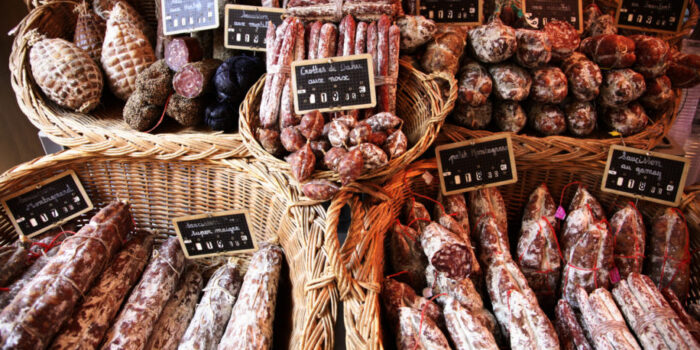
Classic charcuterie comes from France and varies throughout the country. Every region has its own delicacies and specialties and uses ingredients that are available there. But still, you’ll find similarities on every board you order in France. These are the classics that absolutely shouldn’t be missing.

Paté
Years ago, pâté was first created as a way to make useful use of scraps of meat. It is simply a puréed mixture of fat, liver and accompanying herbs.
The most common pâté on a charcuterie board is pâté de campagne, which is made from pork—often liver. It is served in slices and seasoned with onion, pepper and cognac. What other varieties might you come across in France? Pâté in puff pastry (en croûte) or pressed into a mold (en terrine).
Terrine
Terrine is therefore simply the shortened term for pâté and terrine, and is absolutely indispensable on a charcuterie board. A common variety is terrine des trois rois (three kings), which consists of three layers: chicken, foie gras and plums marinated in cognac. This terrine is well balanced in both flavor and texture. The chicken is lightly and freshly marinated with celery and shallot, the plums are compressed and the foie gras provides a classic and delicate flavor.
Mousse
Just like pâtés and terrines, mousses were initially made to use up leftover meat. All three preparations contain liver, but mousse has the highest percentage. This gives it an extra creamy flavor. The meat is seasoned with cream, egg, port, chili flakes, white pepper and coriander seeds.
Rillettes
Rillettes is meat that is cooked in (its own) fat; the meat is then pulled apart and mixed back together with the fat into a spreadable substance. It is traditionally made from pork, but don’t be surprised if you’re served duck or rabbit one day. Good rillettes are easy to spread and have a rich flavor. It may well be our favorite on this list.
Boudin
These soft sausages are made from seasoned minced meat and are cooked, poached or blanched. There are two varieties: blanc or noir. Boudin blanc is mainly eaten around the holidays and is common in central France. Boudin noir has a dark color due to the addition of pig’s blood to the product.
Saucisson
A saucisson is a dried and fermented salami. When traveling through France, you’ll come across countless variations, of which saucisson sec is the most common: seasoned with garlic and black pepper. Near the Alps, for example, the most common type is saucisson aux noisettes: with hazelnuts.
Jambon
Every region in France is known for different hams. Jambon de Paris, for example, is a type with little fat. It is wrapped in its own skin and then cooked in its own juices. Hams are seasoned only with salt, not with herbs or spices. Another well-known type is jambon de Bayonne, the French ham that closely resembles Italian prosciutto di Parma.


