


Korean Recipes for Homesickness
Food editor at large Marjan Ippel doesn’t cook, she eats. When she sees a cookbook, she doesn’t want to — like most foodies — start cooking, but eating. But with Our Korean Kitchen by Jina Pyo and Jordan Bourke, even she ended up behind the counter. A whim, until she can one day sit down at a table in Seoul.

‘There are cooks and there are eaters,’ a wise person once said. I’m an eater. The difference between me and a cook is that as soon as the latter sees a good cookbook with recipes from a particular country or region, they want to start cooking from it. Preferably everything. And preferably all at once. Whereas an eater only thinks: I have to go there!
That’s exactly how I felt when I saw Our Korean Kitchen by Jordan Bourke and Rejina (Jina) Pyo. I have to go to Korea. Now. I’ve eaten Korean food in Amsterdam and Hong Kong, too. But it’s not the same. Sigh.
Korean characters
That yearning feeling starts with the tactile cover. The mysterious Korean characters, rendered in gorgeous blue, cannot only be viewed with the desire to master this language someday. Until that day comes, you can at least touch the language.
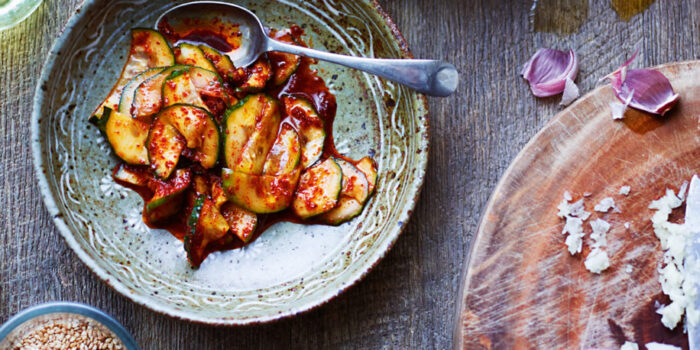
Most of the homesick recipes from Jina Pyo’s native Korea are very achievable
And that feeling doesn’t stop. Not with the endpaper showing a Korean street in faded dreamlike colours. Not with the food photographs in brighter hues, deliberately contrasting with the dreamy Korean atmospheric images. And not with the pages announcing a new chapter, illustrated only with those mysterious characters again, in muted colours and brushstrokes applied with a thick brush. Less is more.
Less is more
That ‘less is more’ principle actually applies to the Korean cuisine introduced in this book, too. It’s a cuisine that is rapidly gaining popularity in Western (street-food) restaurants, but is still much less common among home cooks. There are some Korean cookbooks, but the shelves aren’t overflowing with them yet. Only kimchi (fermented cabbage) has truly made its way into home kitchens here. The authors therefore felt obliged to explain a lot, sometimes step by step.
Most of the homesick recipes that Korean fashion designer Jina Pyo, who lives in London, and her husband, Irish chef Jordan Bourke, collected from Jina’s native country are not complicated or made with countless ingredients. The recipes for classic kimchi, Korean chicken soup (samgyetang), cold cucumber soup (oh-ee neng-guk), and rice porridge with chicken and sesame oil (dakjuk), for example, are even very manageable.
Sticky rice
You do need to have a few basic ingredients at home. Sticky rice, sweet-potato glass noodles, Korean chilli paste, crispy roasted seaweed, toasted sesame oil, and so on. But you can buy those at a small Asian grocery shop or online.
But the techniques aren’t intimidating. Even something like making handmade noodles is doable. Even for an eater. To make the days bearable until she can actually board a plane to Seoul one day…
Make the clear broth with clams, jogae-tang, from this book.
Make the glass noodles with beef & vegetables, japchae, from this book.
Our Korean Kitchen
Jordan Bourke & Rejina Pyo
€ 24.99
Karakter Publishing
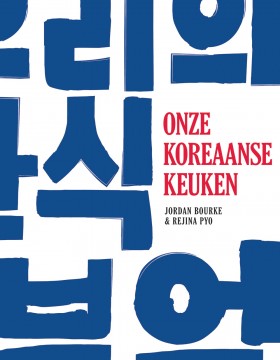
Image: Our Korean Kitchen


