


Norway’s pride: brunost. What kind of cheese is it?
The Dutch are cheeseheads? The Norwegians can give them a run for their money! Their national pride: the special brunost cheese. Believe me, this is a cheese that can’t be compared to any other type of cheese. What is brunost? What does it taste like? And why is it so incredibly popular specifically in Korea?

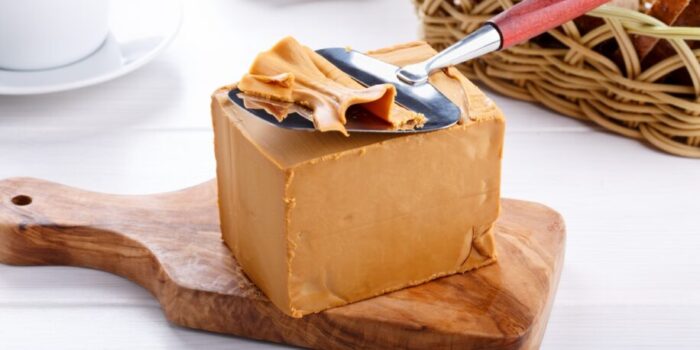
Anyone seeing brunost for the first time is probably immediately confused. It could easily be a huge block of caramel fudge. The brownish caramel color and firm, compact texture don’t suggest that you’re actually dealing with something else. A feast for the eyes, at least. The funny thing is that brunost does taste a little like caramel. But surprise: it also tastes like goat cheese. Brown goat cheese? Huh? Yep, this Norwegian cheese is one big surprise. For your eyes and your mouth.
Brunost: not really cheese
Brunost isn’t standard cheese. Technically, it shouldn’t really be called cheese at all. Brunost is a whey cheese: cheese made from whey. That’s the liquid left over after rennet is added to heated milk. Adding rennet to milk is necessary to make cheese. Normally, the whey—the liquid—is discarded. But the Norwegians decided to turn it into cheese. Or, well, whey cheese. Brunost. We weren’t allowed to call it cheese.
Maillard reaction
So how exactly is brunost made? Because you can’t do much with leftover liquid alone. First, the Norwegians add the whey to a good amount of milk and cream. They boil it for hours. After a while, the Maillard reaction occurs. This means that milk sugars are slowly released, after which the cheese sort of caramelizes. Aha, so that’s where the brown caramel color comes from! Did you know that brunost is actually just the Norwegian translation of ‘brown cheese’?
Goat, cow or a combination
Once the whey mixture has been reduced completely, it is pressed into blocks. The brunost can then be eaten. And I can tell you: expect an explosive flavor experience. You taste a sweet caramel flavor, but also the salty, tangy taste of goat cheese. Brunost is (partly) made from the whey of goat’s milk. Sometimes it’s made entirely from goat’s milk, in which case it is officially called Geitost. That has the strongest flavor of all. The most common variety is a mix of goat’s and cow’s milk. It is mainly sold under the name Gudbrandsdalsost. Finally, there is also brunost made from 100% cow’s milk whey. That is called Fløtemysost and has a somewhat milder flavor.
Compact and sticky
It’s not just the flavor of brunost that is, to put it mildly, rather unusual. The texture of this whey cheese also can’t be compared with other types of cheese. It is very compact and incredibly sticky. Brunost sticks to the roof of your mouth before melting away. Because of its compact and sticky texture, you can really only eat it by shaving it with a cheese slicer. Or, another popular option: grating it with a grater.
Korean fans
Fun fact: brunost is incredibly popular in Korea. Korean woman Jeonmi Eom is responsible for that. That’s why she is also known as the ‘Brown Cheese Lady’. Eom first tasted brunost when her husband, who often has to travel to Norway for work, brought some of the cheese back to Korea. Now the rest of her fellow Koreans have enthusiastically embraced the Norwegian cheese. They sprinkle it on absolutely everything. Ice cream, doughnuts, waffles and even coffee and steak. Brunost on a croiffle is perhaps the most popular: a cross between a croissant and a waffle. Well, why not?
Here in the Netherlands, we haven’t discovered brunost en masse yet. Even though it really is an enrichment to your cheese board and a perfect addition to all kinds of dishes. Sweet-and-salty combinations are simply delicious, aren’t they? So ask your local cheesemonger for a block of brunost. You’ll soon discover why the Norwegians are so proud of it.
Also read:
- I prefer regular cheese to vegan cheese and ended up on the vegan stake
- The best European destinations for cheese lovers
- The most expensive cheese ever was sold in Spain
Source: Atlas Obscura, lekkertafelen.nl


