


Vol-au-vent AKA vidéeke
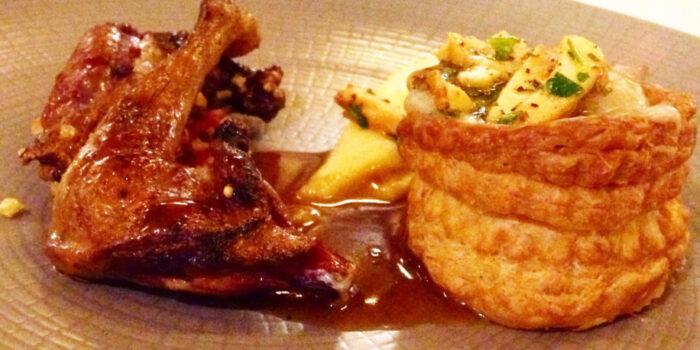
For forever, editor at large Marjan Ippel has been hoping for the comeback of a favorite dish from her childhood: the puff pastry shell. Also known as: vol-au-vent, queen’s bite and, in Flemish, vidéeke. A typical exponent of la cuisine bourgeoise. The cuisine that is making a comeback in Parisian restaurants such as Septime, Enfants Rouges and La Bourse et La Vie. But also at Amsterdam’s The French Connection. Could this finally herald a new Golden Age for Ippel’s second culinary love from her youth after fries?

I ate my first puff pastry shell when I was about six, on holiday in a hotel on our North Sea coast, where all the guests ate their meals together in the large dining room. Something like Fawlty Towers, but without Basil, or in films à la Death in Venice and the recent Youth. I was a fussy eater. But when that mysterious crispy little bowl with its distinctive hat appeared in front of me, my first great love, fries, had to make room from then on.
After that, we would occasionally eat a weak imitation of factory-made shells with tinned ragout at home. But at some point the puff pastry shell disappeared from view, as a result of an urge for renewal. Read: pastafication.
because of the Flemish roots of our love, fries came with that puff pastry shell too, on the side!
Vidéeke
But old love never rusts. And when a new love shows up with your old love on one of your very first dates, that’s a promising start. The puff pastry shell was back in my life. And how: because of the Flemish roots of our love, fries came with that puff pastry shell too, on the side! And suddenly it was called vidéeke, very romantically, presumably derived from vide=empty. In which case the Flemish name, like the French one, refers to the shell without its filling, and over the course of history the part came to stand for the whole.
Speaking of history: not only did the ‘king of chefs and chef of kings’, Antonin Carême (1784–1833), have a major hand in the development of la cuisine bourgeoise, he is also said to be the spiritual father of this vol-au-vent. A dish that, like many legendary examples, is said to have originated by accident. Carême supposedly wanted to use shortcrust pastry for a pie, but mistakenly grabbed puff pastry. When the whole thing began to rise in the oven, he is said to have exclaimed in alarm: ‘Il vole au vent’ (‘It flies away on the wind’).
Rooster testicles
But, as is also customary in food history, this story is disputed too. Perhaps most convincingly by the 1739 cookbook Les dons de Comus ou l’art de la cuisine by François Marin. It mentions the intermediate course petits gâteaux vole au vent long before Antonin was even a twinkle in his mother’s eye.
The shell is still made by cutting two circles from a sheet of puff pastry and placing them on top of each other, with a smaller circle cut from the upper one – the future hat. After the puff pastry circles have risen in the oven, browned and formed into a crispy little boat, it is filled with a creamy ragout and topped with curly parsley plus the aforementioned hat.
Unfortunately, I rarely come across the puff pastry shell in restaurants anymore. With a few exceptions. From Amsterdam restaurant Lion Noir, where it has been on the menu since day one, to Kaagman & Kortekaas, also in Amsterdam. There, a particularly exciting version with rooster combs and testicles occasionally appears on the table.
Who’s next?
Text: Marjan Ippel
Image: Marieke Migchelbrink


