



What is the difference between pale yellow and bright orange cheddar?
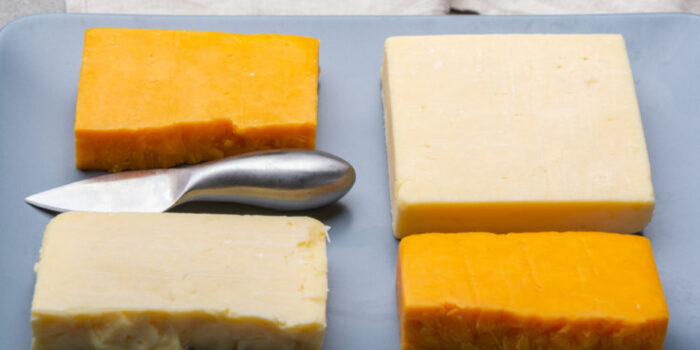
You’ve probably seen it at the supermarket: a little triangle of bright orange cheddar that you have to try to wrestle out of its plastic vacuum-sealed jacket with a razor-sharp knife at great risk to your own life (because that tear-open trick in the accompanying illustration never works). It may also be that you thought cheddar was always supposed to be orange, until you suddenly came across white—or actually pale yellow—cheddar. What’s the story, and what’s the difference?

First things first: I adore cheddar, especially a good, old-fashioned, slightly crumbly one. What I find special is that even really long-aged cheddars, despite being crumbly, are never completely dry. A perfect balance between salty sharpness and not being entirely dried out—and that’s exactly the kind of cheddar I find in England when we visit my in-laws. It’s always white (okay, pale yellow) cheddar, by the way.
Orange on top?
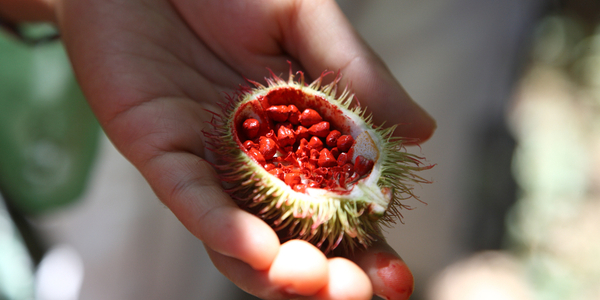
But how does the cheddar we usually see in the Netherlands get that orange color? Through a coloring agent called annatto, which is extracted from the seeds of the tropical achiote tree. Coloring cheese is not exclusively a modern phenomenon, by the way; cheesemaker Brian Gilbert says it has been done for a very long time to give cheese a rich color. Before annatto became so readily available in Europe, cheese producers apparently used marigold petals to create a deeper yellow or orange glow.
Why would you?
And what about white cheddar? The coloring process has simply been skipped. As a result, the color of the cheeses is not always exactly the same, which we actually find appealing and more authentic. Depending on the cow’s diet, her milk will be paler in winter, when there is less opportunity to graze outdoors, than in summer, when she eats plenty of beta-carotene-rich grass in the meadow.
Exciting
Large cheese brands that mass-produce industrially find possible color differences in cheese too exciting and risky. They think customers will leave the cheese on the shelf if it looks a little paler one month than the next, and they strive for uniformity. By adding coloring agents themselves, they can adjust the level to achieve the same color throughout the year. This also applies to many cow’s-milk cheeses in the Netherlands, not just English cheddar. Most Dutch cow’s-milk cheeses are also “painted” yellow with annatto, or E-number 160(b). Just check the ingredients list on the package next time you’re standing in the supermarket…
It makes no difference
Does it make any difference in terms of taste, or what you use it for? Hardly. If you tasted annatto on its own, it would have a somewhat peppery flavor, but because it is such a powerful coloring agent, very little of it is needed. So it would not contribute to a cheese’s spiciness.
They melt the cheeses
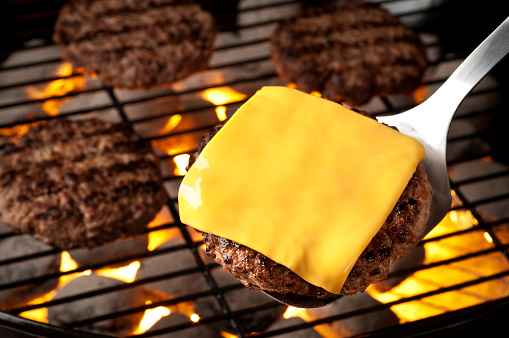
So it seems to be purely a matter of personal preference whether you choose white or orange cheddar when you have the choice. One is no more suitable or healthier than the other. Where there can be major differences is in quality. For a piece of cheddar for your cheeseboard, you’re better off at a cheesemonger, who will most likely be able to provide you with a more interesting cheddar than the average supermarket. But if you’re planning to melt the whole lot for, say, the best cheesy nachos, or an amazing mac ’n’ cheese, a simple cheddar is an excellent choice. So white or orange makes no difference to us, as long as it tastes good!
Read also:
- Is a toasted sandwich just as healthy as a ham-and-cheese sandwich?
- The six best cheese-slicing tools
- Drinks snacks during the coronavirus era: make your own cheese sticks


