


Why Is Goat Cheese White?
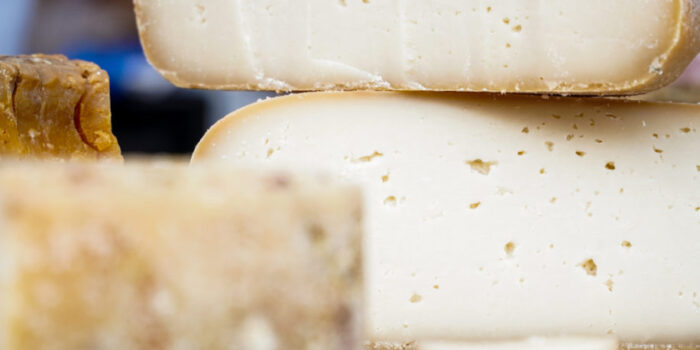
Some things seem so self-evident. Such as the fact that (most) cow’s cheese is yellow and goat cheese is white. But why is that, actually?

The grass that both cows and goats eat contains carotene. In cows, it enters the milk through the digestive system and gives cheese a light-yellow color as it matures.
A goat’s body breaks down the carotene in the grass and converts it into vitamin A instead. That is why the cheese is white.
Coloring
In addition, a lot of cheese is colored. In the past, cows ate hay in winter. Hay contains less carotene than grass, which caused a difference in color. To ensure there was no difference between the color in summer and winter, carotene was added. Nowadays, annatto (a natural coloring derived from the seeds of the achiote tree) is used more often. This is not permitted in organic and biodynamic production, but many other producers do use it.
What about brie?
And what about brie—isn’t that cow’s cheese too? The longer you let cheese mature, the more moisture evaporates from it and the deeper yellow its color becomes. Brie does not mature long enough to become truly yellowish, and it is not colored either. Moreover, brie is made in a completely different way. The mold penicillium candida is added to it, giving it its white rind.
With a raw-milk brie such as Brie de Meaux, you will in fact start to see a difference in color after 5 to 6 weeks of maturation; pasteurized brie generally does not mature for that long.


