



Q&A with top chef Joris Bijdendijk
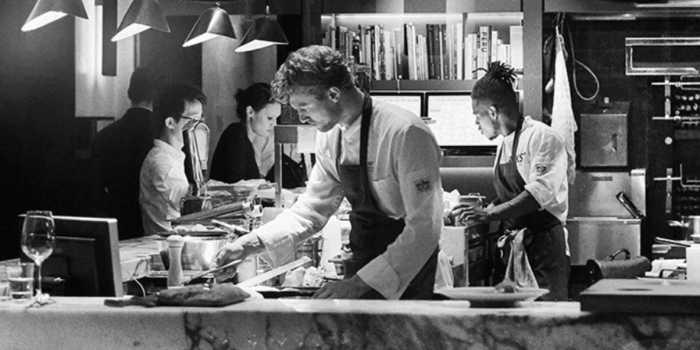
Joris Bijdendijk (33), chef at RIJKS, is one of the most promising chefs in the Netherlands. He has earned two Michelin stars and in 2017 received the prestigious title of master chef, as well as winning the FavorFlav Food Top 100 2017. In this interview, Bijdendijk talks about his motivations and his path to the top. And about his new cookbook, in which he sets out his vision for a cuisine for the Low Countries.

You can officially call yourself a master chef at just 33. What did you have to do for that?
You literally have to take a ‘master’s examination’. For a committee of wise men, you cook your masterful multi-course dinner—with the best you have to offer. It is a process preceded by almost two years of preparation.
What was your ‘masterful dish’?
Pigeon in a salt crust. I think pigeon is a fantastic product. Unfortunately, I can no longer get Dutch pigeons, so it was an Anjou pigeon. I sear the pigeon à la coffre, skin-side down. Then it goes into a salt crust and into the oven for 15 minutes. We serve the pigeon in the crust at the table, with an hourglass beside it. The pigeon then cooks perfectly in the crust for another 15 minutes at the table. We tested that down to the exact minute. We serve the pigeon with parsnip, apple cream, pistachio and a classic becasse sauce made with the pigeon’s liver. The leg is crisped separately. The committee considered it a very worthy main course.
We sauté a lot of black and white truffle in butter, add stock … it is pure flavor
And what else did the gentlemen eat?
A course I am very proud of is the celeriac from the spit, as it also appears in my book. It is a simple, humble vegetable that we turn into a gastronomic dish. Nicely caramelized on the outside. We cut it into thick steak-like slices. Served with an egg cooked at 63 degrees and a winter truffle purée.
For the master’s examination, I made a very decadent truffle sauce. Very decadent. We sauté a lot of black and white truffle in butter, add stock … it is pure flavor. Then you really go all out. We serve brioche with it for dipping into the truffle sauce.
What was your culinary upbringing like?
I was born and raised in Amsterdam, but every weekend our family worked on our farm in the Ardennes. A primitive place, without running water. That is where I learned how vegetables, fruit and animals end up on a plate. We fished for trout in the stream below and whistled through our fingers when we got a bite; my mother would quickly heat the frying pan over high heat and add butter and sliced almonds so we could eat the catch straight away. The wood-burning stove was the heart of the house. My grandfather had a great love of cooking, and that has been passed down through every generation. I remember the poulet de Bastogne, which we bought from our butcher in the Ardennes, with tarragon and leek. We still cook family classics: pork ribs with syrup and tarragon, or leg of lamb with flageolet beans. Belgium shaped me.
It turned out there was a whole new world to discover
When did you know you wanted to become a top chef?
At sixteen, I took a part-time job as a dishwasher at restaurant Pasta e Basta. They roasted bones in the oven, then simmered them over the heat for two days with vegetables, until they had a reduced sauce with the flavor of salmiak and meat. I had no idea something so delicious could be made from bones. It turned out there was a whole new world to discover. In the Amsterdam-Zuid neighborhood where I grew up, it seemed obvious to pursue training as, for example, a lawyer or doctor. But from that moment on, I wanted to become a chef.
How did you reach this level?
At sixteen, I meticulously made a list of things I had to do to achieve my goal. It naturally started with a good education: I would attend hotel management school, which I did. I also put together my own chef’s training program. I would gain product knowledge through internships with butchers, greengrocers and fishmongers. Gain experience at Dutch restaurants, preferably with one of the best chefs. And finally: work for a top French chef. Fortunately, I managed to accomplish all three.
Who are your most important mentors?
First of all, Ron Blaauw, where I started at sixteen alongside my studies. He was the chef at that time. I called Ron: ‘Can you turn me into a good chef?’ I was allowed to come by. A blond preppy kid from Amsterdam-Zuid. The menu featured dishes with combinations I had never heard of: foie gras with mint, almond and madeira. As an amuse, you got deep-fried Dutch shrimp with soy and spring onion. Chefs were still somewhat like pirates back then, and I did not fit that image at all. But Ron soon realized that I was serious. And the Pourcel brothers in France, at Jardin des Sens, where I was able to work afterward. A tough school. But I learned an incredible amount there. Chefs such as Redzepi and André Chiang also came from that school.
What does flavor mean to you?
Flavor is not only what you experience with your tongue; aroma and mouthfeel also play a role. A good dish has everything: the aroma seduces you, it crackles in your mouth, there is a perfect balance between sweet, sour and bitter—it is a flavor bomb. And the challenge is to choose a minimum number of components that go perfectly together.
We now also apply dry-aging to ducks. You have no idea what you’re tasting
Of the five basic tastes, is one your favorite?
First of all, a good dish contains all the flavors. But one of the most beautiful flavors may be umami, or the fifth taste, also known as savory. That flavor comes from amino acids. Just like Parmesan crystals. That is the cheese’s umami. That is why aged cheese is so incredibly delicious.
Which techniques do you particularly like to use?
A great many different techniques and preparations. But at the moment we are doing a lot with dry-aging. Aging meat brings out that ‘umami’ flavor even more. Thanks to the action of enzymes, aged meat also becomes incredibly tender. We have two types: Simmenthaler beef aged for four weeks and for eight weeks. For that, we have a special aging cabinet at De Lindenhoff in Baambrugge. We now also apply dry-aging to ducks. You have no idea what you’re tasting.
In your kitchen, and in your new book too, you champion Dutch cuisine. What is the biggest misconception about Dutch cuisine?
People who say that we have no food culture. Our food culture may not be as refined as the French or Asian, but we certainly do have a food culture. Food culture is determined in part by products and preparation methods. In the Netherlands, we need to create our own product alphabet. When is each product at its best in this country? We have wonderful products: Bloemendaal yellow cabbage, Olde Remeker cheese, authentic cattle breeds such as Brandrode and Lakenvelder. And what about the North Sea, full of beautiful fish?
What is your mission for Dutch cuisine?
I want to show Dutch people the wealth of products we have. During the Golden Age, we were pioneers in importing the finest products, such as vanilla, coffee, tea and spices. But we forgot to enjoy them ourselves. We preferred to eat stamppot or a bowl of snert. Wouldn’t it be fantastic if we could make the culinary arts famous in the twenty-first century? I am working on discovering Dutch cuisine. We have embarked on an incredible journey.
A great many wonderful establishments have been added by a new generation of chefs from top kitchens who are now spreading their wings. Not only very chic places, but also casual establishments where you can eat incredibly well. We are on the eve of a new Golden Age of Dutch gastronomy. We owe a great deal to men such as Cas Spijkers, the Fagels, Halvemaan, Jonnie, Sergio and Ron Blaauw. I am part of, let’s say, the fourth generation. And unlike in the past, we are willing to share all our knowledge and expertise with one another. There is still a great deal of untapped potential there.
What do you think is the most underrated product?
All the lesser-known fish from the North Sea. The bycatch: common sole, dab. We are too accustomed to the standard fish instead of looking at what nature has to offer.
Overrated?
The house steak (called flat iron steak in America): a bare cut of beef with a tendon cut out of it. It comes from a factory-farmed cow that has been force-fed for a few months. It is a blade steak, made tender, and you should grill it briefly like a steak. But a real blade steak is best appreciated when prepared low&slow.
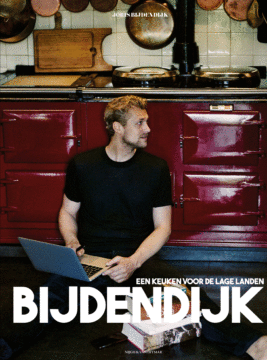
Bijdendijk – A Cuisine for the Low Countries
Joris Bijdendijk
Nijgh & van Ditmar
€ 39.99


