



PLOP – Screw Cap or Cork?
Wine is emotion. And wine always tastes better at the winemaker’s. This is partly even based on facts. Nothing has happened yet – such as storage, transport, or temperature fluctuations – that could have negatively affected the wine. But the passion of a winemaker and their cellar full of atmospheric wine barrels certainly also have a positive effect on how a glass is judged. And so it is with a cork. After the beloved plop sound of uncorking, wine does taste just a little better. And there’s nothing wrong with that either.

The cork oak
In the seventeenth century, natural cork was definitively introduced as a closure for wine bottles. Wooden and glass stoppers, or even oil-soaked rags in the neck of the bottle, were replaced by this ideal sealing method. Cork proved resilient, with cells containing air. Flexible enough to be compressed, and then seamlessly seal a bottle neck. While still allowing a little oxygen through. And a natural product like wine likes that. The longer it stays in the bottle, the more beneficial a little air becomes. All sorts of things still happen with flavours and aromas.
Cork comes from the bark of Quercus suber, the cork oak. Particularly in Portugal and Spain, stripping such an oak has become an impressive craft. The cork oak has to work very hard for all those little corks. Its bark is not stripped for the first time until it is twenty-five years old. The first two harvests are not yet good enough, and it takes nine years each time for the bark to become thick enough to harvest again.
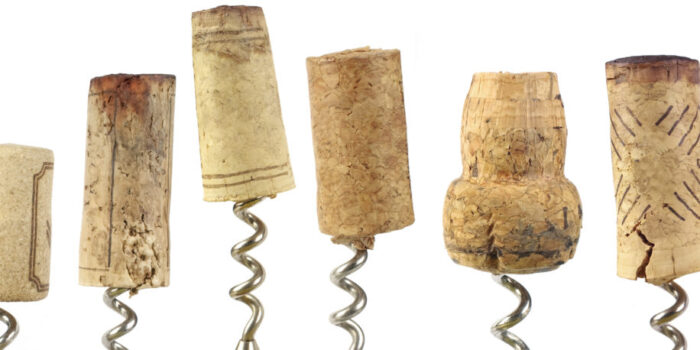
The best corks are punched from whole sections of bark. But often enough, cork is made up of compressed cork pieces. Or there is only a circle of high-quality natural cork on the top and bottom, the so-called twintop.
So one cork is not the same as another, and far from all wine today still needs bottle ageing. On the contrary, the majority of wine produced is meant to be drunk young. Perhaps that cap should be reconsidered too.
Musty, wet newspaper smell
For a long time, cork was the norm. Wine with another closure was cheap and bulk. But in the 1990s, Australian and New Zealand growers switched en masse to screw caps. Most of their wines were made for freshness and intended to be drunk quickly. The hermetically sealed screw cap was a perfect fit for that.
Moreover, cork has a few other disadvantages. Production is labour-intensive and expensive. It can dry out and shrink, meaning the bottle is sealed less effectively. But cork’s biggest disadvantage is: cork. As in the musty, wet newspaper smell found in some bottles of wine. Caused by contamination with trichloroanisole, or TCA for short. A chemical reaction between a mould and wine. This mould is often found in natural cork, which is why cork was long considered the culprit. But it has since become clear that wooden pallets, unhygienic conditions, or even incorrect transport can also cause TCA. So a bottle with a screw cap can have cork taint too! But the chance is a little smaller.
Rotten eggs
Meanwhile, the screw-cap industry has not been standing still either. The oxygen-free cap was not suitable for every wine. No problem for fresh, fruity varieties, but other wines can suffer from it. For example, reduction can occur. With a smell of rotten eggs as a result of sulphur compounds that have nowhere to go. That is why there are now closures that let through no, more, or less oxygen, as desired. This allows the winemaker to carefully plan the development of their wine. Even better than with a cork! That is why you now also see various top estates experimenting with screw caps for their better wines.
All in all, the screw cap is not such a bad idea. It is only its image that still leaves something to be desired. Moreover, a screw cap does not make a plop. And that is precisely what makes it so convivial. To solve that problem, there is now also the Zork. An easy-to-open, reusable plastic cap with a legendary plop experience.
Read also:


