


Bake bread like a pro
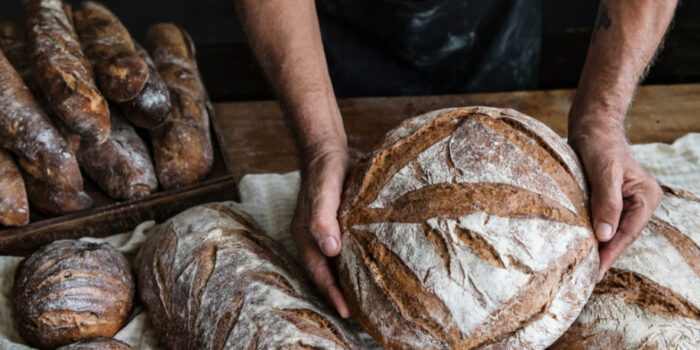
For the past few weeks, I’ve been baking like a maniac. My clothes, face and kitchen are constantly covered in flour. Why? I want to master baking bread. You too? This is how you do it:

I never make New Year’s resolutions. Until, at the end of last year, I stumbled across the Instagram account of Jenna Fisher (Pam from The Office). She had just started baking bread and documented everything on her Stories. I was mesmerised by her bubbling sourdough starter, her airy dough that had risen for twelve hours and then the end result. That sound when she cut into a freshly baked, crackling loaf—wow. And there it was, my first New Year’s resolution ever: in 2019, I’m going to become a pro at baking bread.
https://www.instagram.com/p/Bsqr-1BnrOs/
Since then, I’ve followed dozens of bakers on Instagram. Honestly, there’s nothing more soothing than watching people knead and shape dough. I also bake a loaf every weekend. Obsessive as I am, I immediately bought a book, all the props a baker could ever possibly need, and started baking. There’s something magical about baking bread. For the most basic loaf, all you need to do is mix flour, yeast, salt and water. With the right technique and a whole lot of patience, you get amazing bread. The bread from the local bakery really can’t compete.
Book
A little more about that book. I bought Bread Baking for Beginners and swear by it. The book takes you from beginner loaves (which you don’t even have to knead), to whole-wheat bread, enriched bread (such as brioche) and, as the pièce de résistance, sourdough bread. With each successive loaf, you learn a new technique, so by the end of the book you’re a real pro. Or so I hope—I’m starting my third loaf this weekend.
Patience
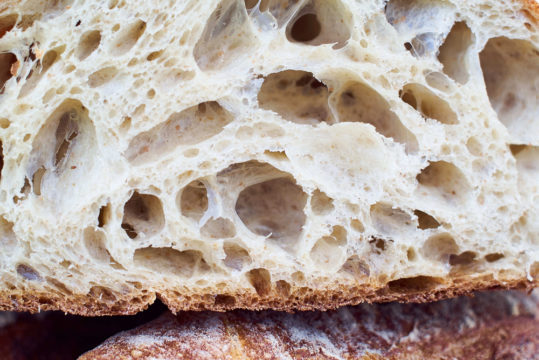
The most common mistake when making bread? Being impatient. If your bread doesn’t rise enough, you won’t get those beautiful air bubbles; instead, your bread will be dense and firm. Ugh. So really pay close attention to the bread and feel whether it is exactly as described in the recipe. Is it not there yet? Then really wait a little longer.
My first loaf had a rising time of eight hours and then had to proof for another hour and a half. Full of optimism, I started at 09:00 and assumed I’d be happily munching on my fresh bread by 22:00 that day. Nothing could have been further from the truth. It was probably cold in my house that day, because everything took an hour longer than the recipe said, and I ended up fighting sleep while waiting for my bread to go into the oven. At 00:30, I took my first bite, and it was absolutely worth it. Really: patience is a virtue. Remember that, novice baker.
Temperature
Another very important factor when baking bread is temperature. You use yeast to make the dough rise, and it’s a living—and therefore unpredictable—product. What can you do to make everything go as smoothly as possible? Control the conditions carefully. Invest ten euros in a digital thermometer and measure the temperature of your flour.
The temperature of your flour is most likely also the temperature of the air in your house. Is the flour cold? Then your water needs to be a little warmer. To do that, I prepare two measuring cups: one with cold water and one with boiling-hot water. Slowly pour them together until the water reaches the temperature you want. A bit of a chore, but this way you stay completely in charge.
Hot oven
It’s also important for the oven to be as hot as possible. For some breads, the oven really needs to be at 250 ºC. Can your oven not go that high? Then simply set it to its highest setting, but make sure to preheat it for a really long time. An hour is perfectly fine.
Does your bread need to bake at 180 ºC? First preheat the oven at its highest setting, then turn it down to the desired temperature. That way, you can be sure it’s properly hot. It can also be worth buying an oven thermometer. Every oven is different, and the temperature you set the oven to isn’t always the temperature it actually reaches.
Pan
Another way to help with the heat a little is to use a cast-iron Dutch oven. Put the pan in the oven while it preheats, then place the dough in it. Be careful, though—the pan is extremely hot. Put the bread back in the oven with the lid on, as this creates steam. That’s also very important for the dough to rise. After about half the baking time, remove the lid so the bread can turn a beautiful brown.
Buy, buy, buy
Are you completely hooked now and do you want to stock up on everything you need to become the best baker in the world (apart from me, of course)? Then be sure to get a proofing basket, in which you let your dough rise. A lame is a kind of razor blade that you can use to make those beautiful patterns in your bread. You can buy them from better (online) baking shops. Neither is essential, but both are great if you want to dive deeper into bread baking.
Also read:


