



Choose your type of salt
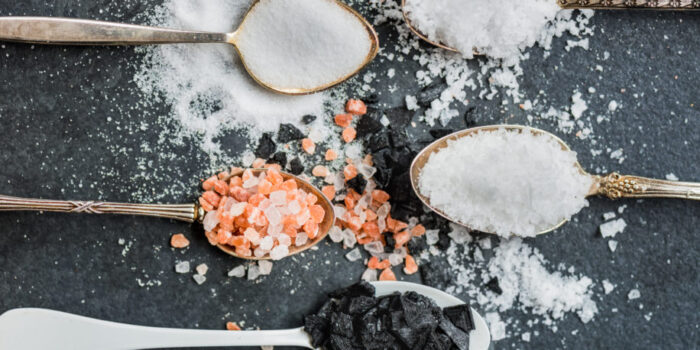
Expensive bright white salt, sun-dried sel gris or basic, cheap table salt: the choice at the supermarket is endless. Which jar do you pick? That depends on what you plan to use it for. Which type of salt should you use for what? We’ll explain.

Table salt
Let’s get straight to the point: table salt is not a type of salt. It’s simply the name for the basic salt you usually use in the kitchen. You almost certainly have a jar of it in your pantry. In any case, it doesn’t necessarily come from the sea and doesn’t always taste the same. However, unlike all the other salts below, iodine is always added to it. We only use this salt to season the water for our pasta or rice.
Sea salt
Sea salt is evaporated from, you guessed it, seawater. There are many different varieties: coarse and fine, each with its own minerals. Because the sea contains toxic substances, sea salt is always thoroughly cleaned before it is put into jars. A well-known type of sea salt is Maldon: salt from England with a mild flavor, often sold in pyramid-shaped flakes. We use this as standard to finish dishes. Ideal: this salt does not dissolve in olive oil. Do you spot kosher salt in an American recipe? That’s simply salt with a coarser grain that quickly absorbs moisture. Coarse sea salt is a fine alternative. Use it to brine your meat or fish.
Celtic sea salt
Celtic sea salt comes in two forms: fleur de sel and sel gris. Fleur de sel is an exclusive, beautifully white and fine type of sea salt that, when it evaporates, remains floating in a thin layer on the seawater. It must then be harvested carefully by hand. This happens mainly along the French coasts and is a laborious and time-consuming task. That’s why the salt is so expensive. You only use fleur de sel to finish your dish. It adds a delicate finishing touch especially to moist dishes, such as carpaccio. Because fleur de sel is not completely dry, it doesn’t dissolve immediately on the dish. It ‘melts’. Another plus: the salt crystals in this variety are not all the same size, so they don’t all dissolve at once in your mouth. As a result, you taste the salty flavor for longer.
Sel gris is essentially nothing more than fleur de sel’s coarse, gray sister. You get it when the salt does not remain floating on the water, but sinks to the muddy bottom due to wind or rain.
Himalayan salt
You’ll find this ancient salt deep in the salt mines at the foot of Pakistan’s mountains. Seawater that once surged against those mountains dried up there. Because the salt is barely processed after harvesting, it contains many minerals that are not found in other types of salt. Iron oxide—rust, in other words—is one of them. That’s also why it is such a beautiful pink color. You usually don’t buy it in a jar, but as a chunk. Use a grater to distribute the salt over your dish. In principle, it’s a fine substitute for table salt, but don’t use too much, because it has a strong flavor.
Hawaiian salt
The lava salt comes from Molokaʻi, Hawaii. How does it get its distinctive color? Seawater is collected in lakes with black lava rocks, but much of the salt also gets a coating of charcoal during processing. This coarse black salt tastes delicious with shellfish and fish and is perfect for giving grilled and roasted dishes a finishing touch.


