


Step-by-step homemade ramen
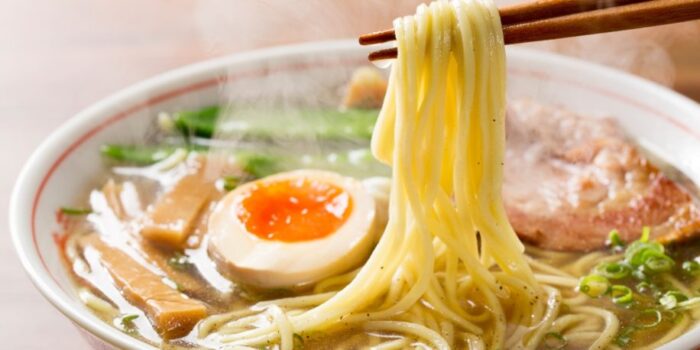
A rich broth with chewy noodles and juicy pork, dried seaweed and a perfectly cooked egg on top. A good bowl of ramen is an art, and making it yourself may well be the most satisfying kitchen task ever. Take your time, don’t be intimidated and make the Japanese noodle soup completely from scratch. I’ll show you how to make ramen step by step.

Let me get you out of the dream straight away: making ramen isn’t something you can do quickly. To extract as much flavour as possible into the broth, it needs to simmer for a long time—much longer than, for example, a ‘simple’ chicken broth. In principle, you can do it in one day, but I always set aside two days. On day one, I make the broth and prepare the pork. It needs to cool completely before you can slice it, so I do that on the second day.
You can make the rest of the toppings on either the first or second day; it just depends on what you feel like. But spreading everything over those two days gives you a little more breathing room, and since there’s plenty of work to do, you can use it.
The broth
Bones
There are as many different types of broth as there are chefs. They’re often pork-based, but there is also chicken ramen or a combination of both. Ramen king David Chang uses a mix, which is also my preference. The pork bones make the broth rich and creamy, while the chicken gives it a slightly more subtle flavour.
Ask the butcher for meaty pork bones; neck bones are best, but are often difficult to find. Shoulder or leg bones are also good. If all else fails, you can use spareribs, but they produce a less intense flavour.
Roasting
To intensify the flavour, you can choose to roast the bones, but it isn’t strictly necessary. It depends on your preference. David Chang, for example, doesn’t roast his chicken, but he does roast his pork bones (1 hour at 200 °C). Ivan of Ivan Ramen in New York doesn’t roast his bones at all, but simply lets them simmer in the broth, together with ground pork.
If you’re using chicken and pork, let the chicken bones simmer for an hour without the pork bones. If you roast the pork bones, you can do this while they’re in the oven. If you simmer the chicken for too long, the flavour can become musty, which would be a shame.
Flavourings
You can flavour ramen with many different things, but most soups contain kombu (dried seaweed) and dried shiitake mushrooms. Often, (roasted) onions, garlic, spring onion, ginger or a combination of these are added too. Don’t let the shiitake and kombu steep for too long either—half an hour at most.
Taré
You may have thought you were done once the broth was ready, but nothing could be further from the truth. Almost every Japanese chef makes a taré, which is certainly just as important to the flavour as the broth. Taré is Japanese for dipping sauce and is a concentrated, almost syrupy sauce based on, for example, soy sauce or miso. When serving, you first spoon a ladleful of taré into the bowl and then pour in the broth.
The noodles
Ramen noodles are much more chewy than Chinese egg noodles or, for example, spaghetti. This is due to the addition of alkaline. Unfortunately, the selection of ramen noodles at Asian grocery stores isn’t particularly good. If you come across fresh ones somewhere, buy them immediately.
Of course, you can also make them yourself. You can add alkaline by using baking soda or buying ‘kan sui’ at an Asian grocery store. It comes in a bottle and looks like water, but alkaline has been added to it. I like this recipe. Whatever you do, always cook the noodles separately from the broth, not in the broth. This prevents starch from getting into the broth and keeps the flavour of the broth from overpowering the noodles. You also want to be able to taste the noodles properly on their own.
The toppings
You can take the toppings in all kinds of directions too, but a few classic ingredients almost always find their way into a bowl of ramen.
Egg
Ramen isn’t ramen without a perfectly cooked and marinated egg. Boil the egg until the yolk is still soft but no longer completely runny. Then marinate it in a mixture of soy sauce, mirin, water and sometimes sugar.
Pork
You can top your ramen with all kinds of meat. Crispy fried Japanese pulled pork is one option, but my favourite (and the most classic variety) is chashu. Pork belly is slowly braised in soy sauce, sake, mirin, sugar, spring onion, garlic, ginger and shallot until it is butter-soft. Then you let it cool completely and, when you’re ready to serve, slice it and briefly heat the slices in a frying pan. The fat melts into the meat and keeps it extremely juicy.
The rest
Nori also belongs in the soup. You know, the dried seaweed you also use to make sushi. Finely sliced rings of spring onion provide a fresh note among all that richness, and in Japan you’ll often get fresh bamboo shoots too. These are difficult to find in the Netherlands, but you can use canned bamboo shoots; they’re just not as tasty.
Burnt garlic oil
My all-time favourite topping is burnt garlic oil. It’s extra work again, but hey, you’re already at it. The oil with burnt garlic, chilli and sesame seeds has a very intense, dark flavour without tasting like bitter garlic. If you still have the energy, definitely make this topping.
Also read:


