



5x pastel de nata in the heart of Lisbon
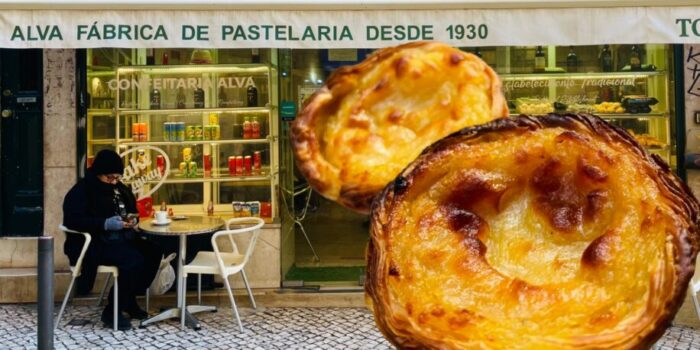
Of course, a lot has already been written about the pastel de nata. And you really don’t need us to find one in Lisbon, since you can hardly walk a few steps without tripping over a pastelaria. But no pastelaria is the same, and they all put their own twist on it. So below are five special pastelarias in or within strolling distance of the heart of Lisbon.

If you really want to find the origin of the original pastel de nata, take the train or an Uber to Belém (fifteen minutes to half an hour west of Lisbon), where this crispy pastry was invented by local monks in the 18e century. The men of the monastery used egg whites to bleach their robes, leaving them with enough egg yolks to feed a village. And that’s exactly what they did: the yolks were used to invent Portugal’s most delicious snack, the pastel de nata.
Five special pastelarias
Anyway, for those who don’t feel like dealing with busloads of Chinese tourists in the otherwise incredibly picturesque UNESCO town of Belém, we have a few lovely alternatives for you.
1. The classic – Manteigaria (price: € 1,40 each)
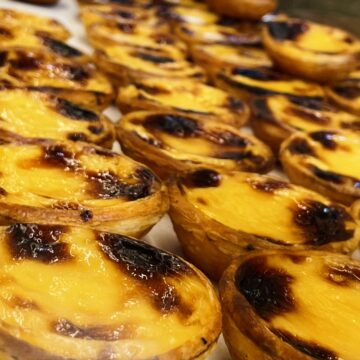
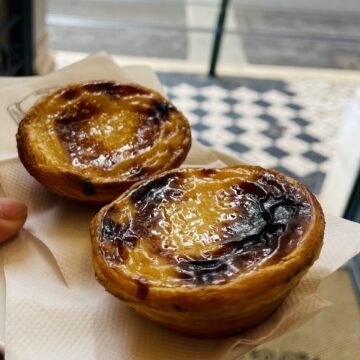
If you only have time to eat one pastel de nata during your trip, make it this one. Right in the middle of Lisbon – on Praça Luís Camões, more or less between Jamie Oliver’s pizza joint and Subway – you’ll find this lovely little place. A pastelaria just as pastelarias should be. No nonsense: there’s coffee and there are pastel de natas. To take away or to devour standing up on the spot.
The pastry is unbelievably crisp and flaky. The lukewarm, silky-smooth filling, not too sweet, vanilla-like with a hint of cinnamon, seeps through the thin caramelized top layer when you take a bite. Divine. Will you make a mess? Probably. But it’s worth it.
2. For the boozers – Casa do Licor Pastel de Nata (price: € 1,15 each + a teeny-tiny drink)
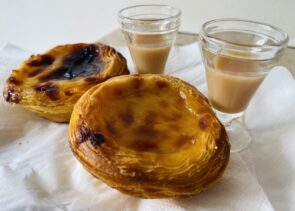
A little farther on from Manteigaria, simply follow Calçada do Combro, and you’ll find a completely different version of the pastel de nata. You could of course save this place for the end of the tour, but a bit of a lush won’t hesitate to stop here.
The pastel de nata itself isn’t as good as Manteigaria’s, but it’s still perfectly decent. The crust is a little less crunchy and the filling a little less delicate and slightly thicker. That means less mess, but it’s not exactly a flavor explosion that makes your life flash before your eyes. But then there’s the drink: that’s actually a little disappointing. With the reasonably priced pastel de nata, you get a tiny glass of licor that wouldn’t even get your hamster drunk. Of course, you can buy a bottle of the stuff. According to the owner of this place, the liqueur is made with the same ingredients as the pastel de nata, but to us it tastes more like ordinary chocolate milk.
3. The vegan option – Vegan Nata Chiado (price: € 1,95 each)
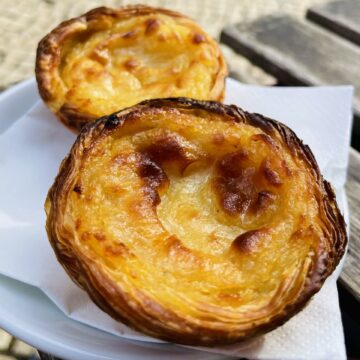
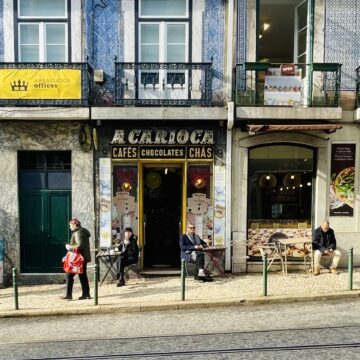
Quickly devouring a pastel de nata standing up before heading to work (or going out – apparently eating a pastel de nata with your friends before entering the club is the new thing here, or so I’ve been told) is great, but sometimes you want to sit down too. On Rua da Misericórdia, you can enjoy some excellent people-watching while biting into a nata. And this nata is vegan too; the owner proudly shows us an official certificate of ‘veganism’, something many other vegan spots don’t have.
Either way, this is a very good pastel de nata. It’s a substantial one that weighs a fair bit. That’s because of the pastry, which consists of quite a lot of layers. The filling is also fairly thick, almost pudding-like. We miss the cinnamon flavor, and it sits rather heavily on the stomach. Luckily, you can sit comfortably here.
4. The trendy alternative – Casa dos Ovos Moles em Lisboa (price: € 1,30 for the ovos moles, € 2,00 for the barquinho
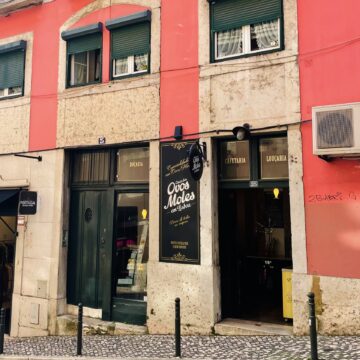
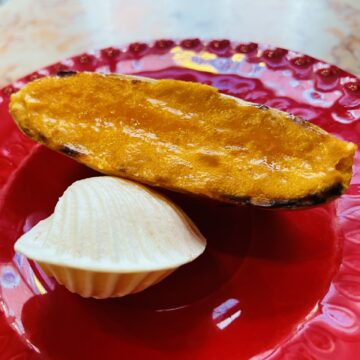
I’ve been told that truly trendy Lisboetas are now seeking out other locally made Portuguese pastries (ridiculous, if you ask me). One of those alternatives would be ovos moles. That literally means ‘soft eggs’, and this pastry is also made from egg yolk and sugar, this time surrounded by an edible-paper-like exterior. Ovos moles are said to have originated in a convent in Aveiro – this time it was the nuns who had leftover egg yolks after their daily laundry. We like it (duh, egg yolk and sugar), but not as much as the nata.
We pair it with a pastry that somewhat resembles an éclair: the barquinho, also originating from northern Aveiro. The filling is deliciously thick and yellow, while the outside is a little reminiscent of a children’s ice-cream cone. It’s not a true alternative to the pastel de nata. These two are more like snacks, whereas the pastel de nata should of course be the main attraction of your coffee break.
5. Where the locals get theirs – Pastelaria Alva (price: € 1,90 each)
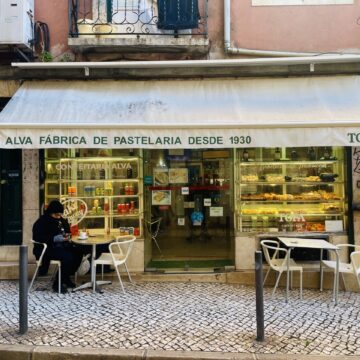
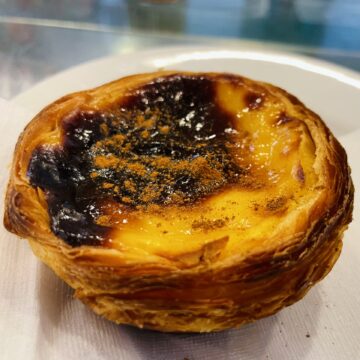
All these places in the center are nice, but perhaps a little too touristy. No worries, follow the aforementioned Calçada do Combro west toward the São Bento neighborhood until you reach Pastelaria Alva. This area used to be packed with local pastelarias; now Alva is the last man standing. There’s no English menu here, but there are local old-timers reading the newspaper, a small TV in the corner and… lots of pastries. Naturally, we’re here for the pastel de nata, which is surprisingly expensive here. Unlike at the other places, it’s served at room temperature.
But that actually doesn’t matter at all. The pastry is crisp, the flavors intense, the filling perfectly balanced, and the owner, Antonio, gives us a tube of cinnamon so we can customize it a little. This is how it should be: at eleven in the morning, standing up and watching Portuguese news you don’t understand a word of, with a delicious dark-colored pastel de nata with lots of canela – cinnamon – in one hand and an extra-strong bica – Portuguese espresso – in the other.
Also read:


