


About the Oosterschelde Lobster #1
This year, the Oosterschelde lobster season runs from March 30 through July 15. After that, Zeeland lobster will still be available while supplies caught during that period last. It is therefore a seasonal product. That means: enjoy it now.

In a three-part series, we tell you everything about buying, preparing and eating it. With thanks to lobster whisperer Jakob Doorn, who has been buying and selling for fish wholesaler Jan van As for thirty years. His portfolio includes the higher-end restaurant segment (think: Waldorf Astoria, De Librije) and the Japanese market. Jakob is also the author of Vis & Seizoen. Jakob: ‘Fish caught in season is not only sustainable, but also has more meat.’
Part 1. From purchase to tail
1. Recognize the Oosterschelde lobster
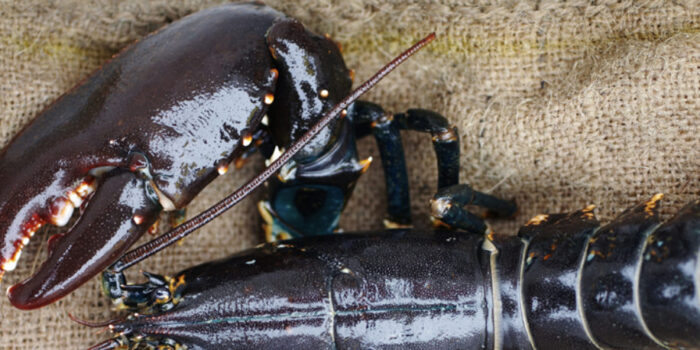
The lobster from Zeeland (homarus gammarus) is actually a disguised European variety that is caught in the Oosterschelde. If it swims 50 meters farther away, we call it European lobster. While the European lobster is bluish in color, the one from the Oosterschelde is almost black. Often with red feelers and white spots on its shell. The tail is beautifully bright blue. The Canadian lobster (homarus americanus), for example, is brown-green.
2. Why so expensive?
Unlike Canadian lobster, which is caught and sold virtually all year round, Oosterschelde lobster is a seasonal product. It may only be caught by a handful of fishermen, within a limited period and a limited area. And so it is scarce. And scarcity drives up the price. Up to twice that of a Canadian lobster.
3. Dead or alive?
First of all: always buy the lobster alive. There is no alternative. If it is dead, you never know how long it has been that way. And you could become seriously ill. A lobster tank (a lobster aquarium with running water) guarantees the best quality and taste.
4. Recognize the quality
Pick up the lobster by its head. No, it is not scary. Its dangerous claws are tied shut with elastic bands, after all. Gently squeeze the head. It should feel nice and firm, not soft or yielding. Jakob Doorn: ‘Also check that there are no eggs hanging from the underside of the tail. Those eggs are the future, so you should not want to eat them. Moreover, they can make your stock cloudy, for example.’
5. Storing
Ideally, the seller will give you the lobster in a box in which it can be transported free from drafts. Shellfish do not like drafts or temperature fluctuations. Store it in that box in the refrigerator until use. Cover it with a damp tea towel. This gives the lobster the greatest chance of staying alive. If it dies in your refrigerator, don’t panic. Nothing is wrong, provided you process it within a reasonable amount of time.


