


Beware: these are our grossest dishes ever
‘It’s a dirty job, but someone has to do it‘, we sometimes jokingly say to each other in the FavorFlav editorial office when we’re dining at yet another new (starred) restaurant. But sometimes, very occasionally, it really is a dirty job. These are the grossest dishes we ate (for you).

Looks like a turd and tastes like one too
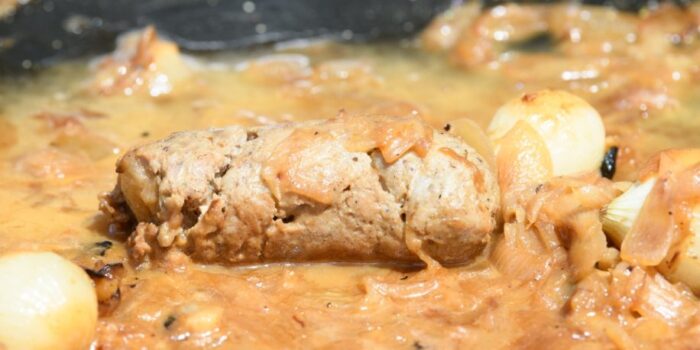
Sharon: “In the never ever again category: the French horror sausage Andouillette. I was once served this turd on a wine trip through Beaujolais. At Les Rendez-Vous de Bobosse, to be precise. A true pilgrimage site for many a French person. Rolled up on your plate, ‘France’s most feared specialty’ still looks like an ordinary, harmless sausage, but when you stick your knife into it, an unbelievable smell comes out! Have you ever smelled a body in an advanced state of decomposition? Neither have I, but this immediately sprang to mind. And then there’s the texture. Slimy with hard bits, brrrrr. Fortunately, there was enough wine on the table to wash the sausage down with.”
Did I just see an eye?!
Delilah is no fan of authentic French regional cuisine either: “With Tête de Veau, the French once again prove that they aren’t gastronomic wimps, while I sat there trembling slightly behind my plate. Because did I just see an eye?! And it had all started so promisingly. I had enjoyed the salade gésiers, tucked into the best pouletjes and rôti de porc, and then that earthenware dish appeared on the table… I don’t know whether this was a traditional version, because it wasn’t boiled calf’s head in slices (not exactly delightful either), but at first it looked like a nice coarse pâté to me. There was some jelly in it, okay, I could still handle that, and in my somewhat practiced French I asked the hostess about it. She pointed to her head and rattled something off; it wasn’t immediately clear to me whether she simply thought I was crazy, so I dutifully spread some of it on my (divine) baguette. The smell wasn’t entirely to my liking, but oh well… And then something cracked. Literally, between my teeth. I took another good look at the dish, and to cut a long story short: I really never need to eat tête de veau again.”
Fruit with a travel ban
Marcus: “The nastiest thing I ever ate—and will never, ever eat again—is durian. Perhaps the most notorious fruit in the world. Sold at food stalls in Thailand, Malaysia and Singapore, among other places. The smell of this spiky fruit is so overwhelmingly pungent and indescribably disgusting that in Singapore, where I had my first durian experience, it is forbidden to take the fruit on public transport or to your hotel. Anthony Bourdain once described eating durian as ‘your breath will smell as if you’d been French-kissing your dead grandmother’. I would describe it as: vanilla custard with fresh vomit, garlic, mature cheese and moldy socks, with a strong whiff of open sewer. Durian: you love it or hate it. I belong to the latter category.”
Cheese fondue pizza
Snackspert: “Domino’s cheese fondue pizza. One of the toppings was potatoes. Now, I don’t know whether Mr. Domino throws cold, soft potatoes into cheese fondue in some backwater village, but in any case, you don’t put that on a pizza. In addition, the cheese fondue was exceptionally low quality, the kind you wouldn’t be served at an average Christmas dinner. No, this was genuinely the grossest pizza I had ever eaten. New York Pizza’s satay pizza comes close, but the cheese fondue pizza is the only pizza that had me hanging over the toilet 17 minutes later—and not because I felt like it, no, precisely because I simply had to. Unfortunately.”
A pale, half-soft mouthful of fat
Laura: “In Colombia, things are quite manageable culinary-wise, despite their bizarre eating habits. Still, I also ate something extremely disgusting there. I ordered chicharon, a well-known Colombian dish: deep-fried pork fat. When fried properly, you get an incredibly crunchy dish that goes down easily, like a bag of crisps. In this case, the oil wasn’t hot enough or the fat hadn’t been in it long enough. Either way, the result was a pale, half-soft mouthful of fat. Horrible! Fortunately, we later found the most delicious chicharons in Medellin at El Social! So if you’re in Colombia: try chicharon there, not in the village of Villa de Leyva.”
Lost-in-translation sushi
Sabina: “In Japan, my husband and I couldn’t read the menu. I do have a translation app on my phone, but it only works when there’s Wi-Fi, and most restaurants don’t have that—or perhaps I couldn’t read that either. So we usually ordered random things from the menu. After an evening of eating sushi in Hiroshima, we checked in the hotel, using photos of the menu in the app, what we’d actually had on our plates. Those strange fishy green rolls? A little slimy, with hard bits? The ones we both ‘didn’t really’ like, but ate anyway, followed by a big sip of sake? The translation app said ‘insides of the squid’. Squid innards: not to be repeated.”
Rotten fish as a delicacy
Vincent still shudders at the mere thought: Surströmming. “This Scandinavian delicacy caused the food I’d eaten earlier to slide back up my esophagus, in the middle of a respectable Swedish restaurant. I always dread herring-party season anyway, because I find the sickly fish smell and the texture of this moist fish, combined with the armpit smell of fresh onions, repulsive enough, but this is the ultimate version. It’s fermented Baltic herring—in other words, rotten fish that practically explodes inside the can. A fitting punishment for terrorists: eat Surströmming for breakfast every day. The fish ferments when it’s left in the sun, creating the sulfurous stench of 1,000-year-old rotting eggs that you can never get out of your nose. The salty-smelling fish is often eaten outdoors, to prevent fellow diners in a restaurant from staring at you accusingly.”
Deadly little fish
Marcel, our Man in the Provinces, occasionally ventures out of the provinces too. It wasn’t even all that gross, but definitely not worth repeating: “Fugu. In other words: pufferfish. Or: potentially deadly. Because incorrect preparation of this fish causes all your muscles to stop working, including, eventually, your heart. And according to experts, you’re fully conscious throughout the entire process, so you realize you’re dying and can do absolutely nothing about it. That, knowing this, I still ate it twice in one week, I continue to consider one of my greatest acts of heroism ever. And my stupidest too, but I blame it on the sake. And on the fact that both times it was at a three-Michelin-starred restaurant in Tokyo. Either way: never again.”
Pork belly with skin and hair!
Steffi: “Noodle soup with pork belly. Now I hear you thinking: huh? Isn’t that just delicious? Correct. But in Nagaland—which isn’t a restaurant in Disney, but a province in northeastern India—they eat that pork belly with skin and hair. Mmmmmm. The skin was rough and (literally) hairy, there was no meat on it and the fat was simply jellied and slippery. Leaving it was not an option: firstly because our host had proudly taken us to that restaurant (his favorite), and secondly because, surrounded by so much poverty, I became extremely aware of how decadent it actually is to be able to choose not to eat something. Incidentally, the next day the same host invited us to his home to eat ‘chicken legs’. Read: nasi with chicken claws. One thing is certain: in Nagaland, they don’t believe in waste.”
Read also:


