



Can I still eat my avocado or not: a guide
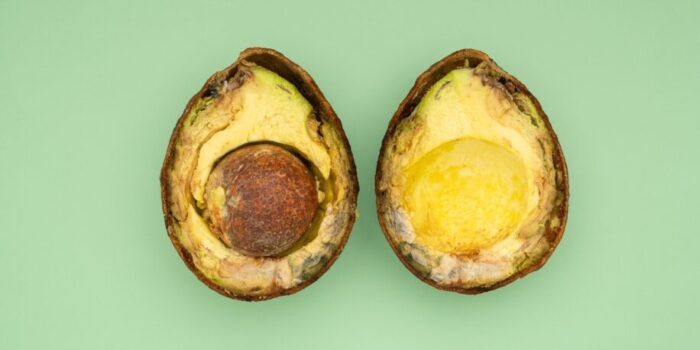
Oh, how you’ve been looking forward to it: that delicious millennial lunch with avocado and a poached egg. You had to wait a while for the avocado to ripen, but now it feels just right. You cut it open, twist the two halves apart around the pit and then… F%^GW^HGF#QD$. The avocado has fooled you again. Brown, grimy spots, nasty flesh: it doesn’t look appetizing at all. But throwing it away would be such a waste (that thing costs a fortune). Can’t you just eat this avocado after all?

Today, you’ll get an answer to this burning question. Think of it as your avocado bible, the definitive “Is my avocado still edible?” guide, your avo guide—call it whatever you like. Keep it handy even if you’ve already cut the avocado in half and saved one half. In other words, if you knew you were taking the risk of ending up with a nasty, ugly avocado. We have an answer for you in that case too.
Help, my avocado is stringy!
This has everything to do with temperature. If you store avocados at too high a temperature during or after ripening, a kind of stringiness develops. The same applies if ripe avocados cool down too quickly. Strands of cellulose fibers that haven’t fully ripened become visible—that’s the stringiness. It isn’t dangerous to eat, but it certainly isn’t pleasant. Decide for yourself whether you’re willing to eat it.
Help, there’s an air pocket in my avocado!
Admit it: you poke, squeeze and press avocados too. After all, that’s the way to test whether an avocado is ripe (not everyone has a smart avocado computer or an X-ray machine). If an avocado gets bruised by all your poking and prodding, it temporarily swells up. After a while, a small space remains between the flesh and the skin. The air pocket, in other words. The flesh near the air pocket is highly susceptible to mold. Do you see or smell anything that looks like mold? Then there’s no doubt: your avocado belongs in the trash.
Help, my avocado has hard bumps!
When an avocado is attacked—for example, by insects—it defends itself. It then produces small, hard bumps close to the skin. You can eat them, but just like the stringiness, they don’t necessarily make for a pleasant mouthfeel. So cut around them if necessary and eat the bump-free flesh.
Help, my avocado has brown streaks and spots!
This may be the most common problem with avocados: brown streaks and spots. They often appear when, for example, you eat only half an avocado. In other words, when you take that familiar risk. If you save the other half, those brown streaks and spots will appear in no time. That’s because the avocado is exposed to oxygen. A chemical reaction then produces melanin, which causes brown spots. No, it doesn’t look very appetizing. But it won’t kill you. An avocado in this condition is still perfectly fine to eat. Cut away the spots if they really make you feel sick.
Help, my avocado is completely brown!
It may also happen that your (cut-open) avocado half has turned completely brown. Don’t panic right away: often, it’s only the part that was exposed to oxygen. The outer layer of the flesh, in other words. This is perfectly safe to eat. It may taste slightly bitter, but it won’t make you ill. Here too, you can cut away the brown top layer if you like. And be sure to check out this tip for preventing your avocado half from turning brown quickly.
Has your avocado been untouched for 1.5 weeks (so it hasn’t been cut open) and is it completely brown and soft when you cut it open? And does it also smell rotten? Then there’s nothing left to salvage. Throw it away.
Read also:
- Research shows that eating avocado is incredibly healthy
- The best way to ripen an avocado (tested!)
- This is the difference between green and brown avocados
Sources: HuffPost, The Kitchn


