



Collecting supermarket loyalty stamps? Not you, but supermarkets mainly benefit from this
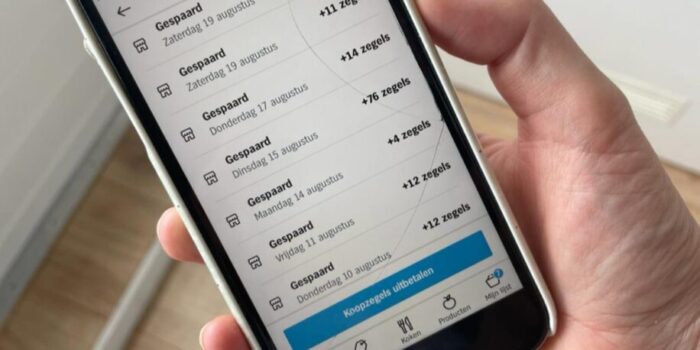
“Would you like to add loyalty stamps?” Anyone who used to work behind the checkout at Albert Heijn, Jumbo or PLUS may have said this sentence thousands of times. These days, collecting loyalty stamps is done digitally, and that sentence is becoming a thing of the past. Either way, you can still collect loyalty stamps. But here’s the thing: supermarkets in particular are cashing in on their own savings programmes.

I know quite a few people who have been avidly collecting loyalty stamps for years. At our house, there were stacks of stamps waiting to be — well — licked and stuck into savings booklets. A few times a year, you handed in those booklets and received a nice little payout from the supermarket. These days, the loyalty stamps are neatly displayed in the app. At a glance, you can see how many stamps you still need for a full (digital) card. In other words, how much more money you still have to spend on groceries before you receive your payout.
Supermarket savings programmes
Albert Heijn, Jumbo, Plus, Vomar and Coop are the largest supermarkets with loyalty-stamp savings programmes. RTL Nieuws listed exactly what their savings programmes involve. How much do you pay for a stamp, what return do you get and, ultimately, how much do you have to spend on groceries for a full savings card? At virtually all supermarkets, the same principle applies: you receive one stamp for every euro spent on groceries, and pay an additional amount of X for each stamp.
Albert Heijn
Very few supermarkets have as many people participating in a loyalty-stamp savings programme as Albert Heijn. According to RTL Nieuws, no fewer than 2 million people collect stamps at the large blue supermarket chain. You pay 10 cents for one Albert Heijn loyalty stamp. A full savings card contains 49 stamps. That card has cost you €49, and you have spent €490 on groceries to collect them. Albert Heijn pays you €52 when you hand in the booklet. That is a return of 6%.
Jumbo
At Jumbo, you also pay 10 cents for a loyalty stamp. A full savings card costs you €2.50, for which you have spent €25 on groceries. Jumbo pays you €26 for a full savings booklet. The return is 4%.
PLUS
Do you collect loyalty stamps at PLUS? Then you pay 2 cents for each stamp. A full savings card ultimately costs you €4. For that, you have spent €200 on groceries. PLUS gives you €6 back for your full booklet. That is a return of no less than 50%.
Vomar
As with Albert Heijn and Jumbo, you pay 10 cents for a loyalty stamp at Vomar. A full savings card costs you €47.10. A quick calculation shows that you have spent €471 on groceries for this. What does Vomar give you for your full savings card? €50. That means you get a return of 6%.
Coop
Anyone collecting loyalty stamps at Coop pays 5 cents for each stamp. A full savings card earns you €25. To collect it, you must have spent €250 on groceries. If you hand in your full card, you get €26 back. So the return is 4%.
Hey, big spender!
One thing is clear: you have to do a lot of grocery shopping to save even a little. And that is where the supermarket benefits. Just look at Albert Heijn. To fill a booklet, you have to spend €490 on groceries plus €49 on that full booklet. The supermarket advertises this as a 6% return, but in reality it only ‘costs’ the supermarket 0.6%. A mere pittance for such a large company.
It also takes a very long time to fill a booklet and benefit from that return. In the meantime, you keep doing your grocery shopping at the same supermarket. If you go somewhere else, it feels as though you have been saving for nothing. And so, without you probably realising it, the supermarket has turned you into a loyal customer.
Profiting
As consumers, saving feels very easy to us. You always have the app with your collected stamps at hand, and it feels as though it takes almost no effort to eventually claim that return. With every shop, you pay a little extra, so to speak, ‘in exchange’ for extra money later. You are rewarded for what you do. The result: you spend even more — and the supermarket profits even more. As if they weren’t already profiting hugely from those expensive groceries in the first place…
Is saving at the supermarket safe?
Saving at the supermarket is therefore popular. But is it actually safe? As safe as saving money with a bank, for example? No, saving at the supermarket does involve somewhat more risk. This is because there is no deposit guarantee scheme: a system that banks do have. The deposit guarantee scheme is a kind of safety net for savers if the bank goes bankrupt. Consumers do not lose all their savings, but are guaranteed to receive amounts up to €100,000.
What if the supermarket goes bankrupt? In most cases, you are simply out of luck. But there is no real reason to panic. Supermarkets do not go bankrupt just like that. A Jumbo spokesperson told RTL Nieuws that supermarkets are more likely to be taken over than to close their doors for good.
And one more thing: it is not the case that supermarkets are completely unsupervised. In short, supermarkets must meet certain conditions to be allowed to ‘tempt’ customers into saving with them. This is something that, strictly speaking, only banks are allowed to do, but supermarkets are also permitted to do so in exceptional circumstances. One of these conditions is that customers may only buy stamps when they also purchase other groceries. Buying individual stamps is therefore not possible. This means that, as a loyal customer, you are still somewhat protected from the big supermarket. And perhaps also a little from yourself.
Also read:
- 11 tips for saving a huge amount of money at the supermarket
- Save money on groceries: wonderfully easy with these 5 apps
- 10x the best tips and tricks for saving money on food
Source: RTL Nieuws


