



Employees of hugely popular food magazine Bon Appétit speak out about racism and the boss steps down
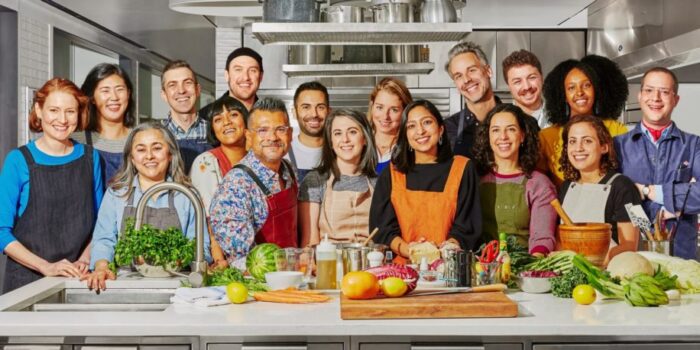
Adam Rapoport, editor-in-chief of Bon Appétit, is stepping down. He announced this on Monday, a few hours after a racist photo of him and his wife surfaced on Twitter and several (former) employees opened up about how things work at the extremely popular magazine.

Those who have been following us for a while know that we are big fans of Bon Appétit in the editorial office. Their recipes, videos, photos and texts: everything looks fun, delicious and welcoming. Working on their editorial team really seemed like a dream to me. But as Marco once sang: most dreams are deceptive. And this dream certainly falls into that category, because from the outside Bon Appétit may look like that perfectly shiny apple, but inside it turns out to be completely rotten.
What happened?
Editor-in-chief Adam Rapoport is leaving, as he announced on Instagram on Monday in a post saying that he was stepping down “to reflect on the work he needs to do as a person and to make Bon Appétit a better place.” Rapoport was previously an editor at GQ; since 2010, he had worked as editor-in-chief of Bon Appétit. All in all, he had therefore worked for Condé Nast, the parent company of the two magazines, for 20 years.
https://www.instagram.com/p/CBMT4rVg0H4/
But why is he stepping down?
A few things: a photo from 2013 of Rapoport and his wife Simone Shubuck appeared on Twitter, showing the two dressed up—probably for Halloween—as brownface, a variation on blackface, better known to us as Black Pete. Something that a large part of the Netherlands still seems not to realize is extremely racist, but do your homework: it absolutely is.
I do not know why Adam Rapoport simply doesn’t write about Puerto Rican food for @bonappetit himself!!! https://t.co/rW0k5tjMoS pic.twitter.com/odZnFLz2gd
— TAMMIE TECLEMARIAM (@tammieetc) June 8, 2020
The photo was posted after freelance editor Illyanna Maisonet posted screenshots of a conversation between her and Rapoport about why her pitch for an article about Puerto Rican rice fritters was not published because it was not new enough, while an article by white editor Molly Baz about Piñones—the most talked-about region of Puerto Rico—was.
https://twitter.com/eatgordaeat/status/1269329628658712576
Aside from the fact that this conversation shows that Molly’s name may have been on the article, but it was written by a Puerto Rican freelancer (?!?!), the conversation and the photo also prompted (former) employees to speak out.
Unequal pay
For example, Sohla El-Waylly, a chef and restaurateur who was hired as an assistant editor at Bon Appétit last year and occasionally appears in the hugely popular BA Test Kitchen videos, opened up on Instagram. In her stories, she wrote that she not only received a salary of $50,000 a year (around €44,000) “to assist white editors with considerably less experience than me,” but was also “pushed in front of the camera as a display of diversity,” without receiving compensation for it—unlike the white editors.
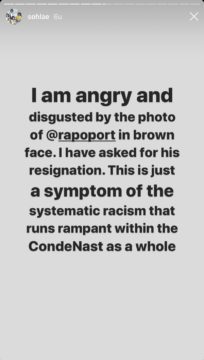
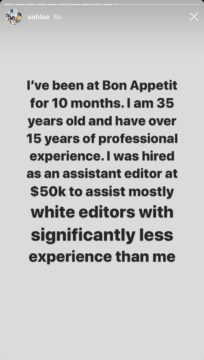

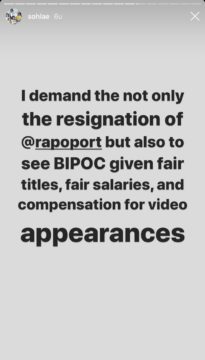

Following El-Waylly’s post, editor and Test Kitchen personality Molly Baz also spoke out, saying that she would no longer appear in videos until her BIPOC (Black, Indigenous, and People of Color) colleagues received equal pay and compensation for video appearances. Fellow editor Carla Lalli Music said she would join Baz.
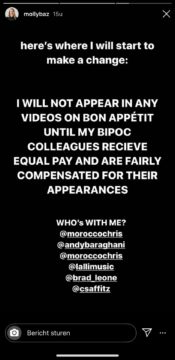
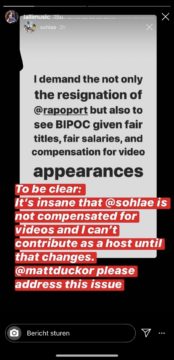
Condé Nast denies in Variety that white editors are paid for their video appearances while editors of color are not. The spokesperson would not comment further.
No change despite repeated calls
Meanwhile, Alex Lau, a former photographer at Bon Appétit, also spoke out on Monday on Twitter. And he does not mince words. “One of the biggest reasons I left BA is because the white leadership refused to implement the changes that my BIPOC colleagues and I constantly pushed for.”
“When I asked, ‘Why have we photographed all kinds of food from around the world, but skipped the entire continent of Africa?’ their answer was: ‘Oh, you know, the recipes are too difficult and readers don’t want to make those dishes.'”
“Oh, but you do preach the wonders of three-day recipes and 60-hour stews,” he tweets skeptically.
when i asked “why have we shot food all around the world, but haven’t touched the entire continent of Africa?”, their response: “oh you know, the recipes get tricky, and readers probably wouldn’t want to make the food”.
— Alex Lau (@iamnotalexlau) June 8, 2020
Work to do
It is clear: there is work to be done at Bon Appétit. And not only there. Just as Alex Lau holds all of Condé Nast—which also includes Roger Moore and Anna Wintour—accountable for the culture they have created, the entire media world—it includes us too—must become more aware of its role, responsibilities and opportunities for change.
Photo: Bon Appetit Test Kitchen team photographed by Laura Murray/Bon Appétit
Also read:


