


English increasingly becoming the language spoken on Dutch terraces: problematic
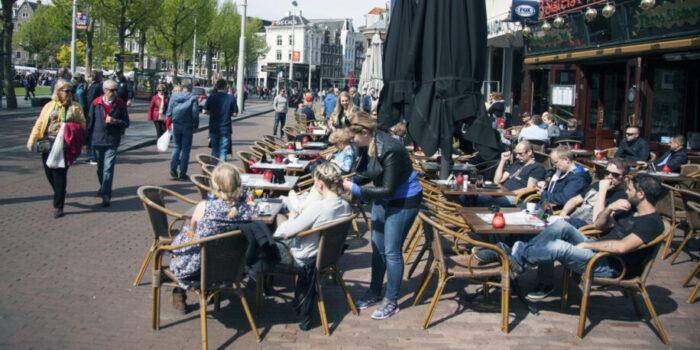
I’ve noticed it myself more and more: you’re being served on a terrace and immediately addressed in English. By now I’m used to it, but it is still a little strange. And especially inconvenient, because some things are simply difficult to order in English.

Take a vaasje, bitterballen or an uitsmijter, for example — typically Dutch terms that sound rather odd in English. ‘I would like an uitsmijter with bitterballen on the side and a vaasje to drink, please.’ It sounds ridiculous.
‘Not everyone speaks English’
But according to AD, that is not the only issue. They spoke to FNV Horeca about this increasing use of English on terraces, and they are seriously concerned. It begins: ‘Not everyone in the Netherlands speaks fluent English.’ But perhaps even worse: Dutch employees no longer always feel comfortable in the workplace, because the language spoken between colleagues is also increasingly tending towards English.
A bigger staffing problem
‘There are now Dutch employees who feel like strangers in their workplace because the company is switching to English. This could also cause these people to leave. That only makes the staffing problem even bigger.’ That is why FNV Horeca wants to encourage foreign employees to use more Dutch. Admittedly, we do have quite a challenging language to learn, but if you plan to stay here for a longer period of time, it might be useful.
No English? No order
But it can always be worse, says linguist Wim Daniëls: ‘I recently received a letter from a woman who had been thrown out of a place in Amsterdam because she refused to place an order in English. Apparently things have already gone that far, but it does not surprise me either. This development is connected to our mobility. Everyone is constantly travelling all over the world. If there is one thing a language cannot withstand, it is people moving to live everywhere. Dialects have almost disappeared partly for that reason.’
Bizarre, if you ask me. Bizarre that this woman was thrown out of a place for that reason, but refusing to speak English is also not a hill I want to die on. And yes, I realise that is English.
A perfectly poured whistletje
Hospitality owners are also finding it increasingly difficult to deal with: they are seeing more and more employees who do not speak Dutch, except perhaps for ‘good evening’ and ‘bon appétit’. But what can they do about it? The staff shortage in hospitality is still a major problem, so I can well imagine that they are happy to hire foreign employees. Personally, I do not mind that things are becoming increasingly English, as long as people are friendly and bring me my whistle (whistletje?!) beautifully poured. That is all I need.
But hey, what do you actually think?


