


Foodlingo: Fish & Chips
Food editor at large Marjan Ippel regularly introduces a new or recently reintroduced term from the food scene here, the so-called foodlingo. No foodie can do without it. After all, ‘what (not) to speak’ is at least as important in food as ‘what (not) to eat’.

This time: fish & chips
The (gourmet) burger market is gradually becoming a little saturated. Time for a fresh sea breeze. Time for fish. Fish? Not just any fish. But deep-fried in a batter jacket and answering to the name ‘fish’. Moreover, always accompanied by its regular partner ‘chips’.
Fish café
On almost every street corner, a hamburger joint modeled on American establishments has sprung up in recent years. And surprisingly enough, it is not the equally American hotdog bar or steakhouse, but the originally British fish & chips shop that is now breaking this monotony.
Fish restaurants are currently opening in droves. Some haute, such as Amsterdam fish-tronomy bar John Dory, but more often not. In this way, fish cafés are finally filling the gap in the hospitality industry created when the popular neighborhood eatery was swept aside by the star chefs at the end of the last century. A café you went to for a beer and a simple, unpretentious meal of the day. In precisely that tradition, today’s fish café serves simple fish fare at affordable prices in a casual eatery setting.
Bycatch
And when talking about simple fish dishes, it soon becomes a conversation about fish & chips – the British national dish that many of us know only from newspaper wrapping soaked with vinegar and old frying fat, on which whole pieces of limp, deep-fried cod or haddock and chunks of fries float.
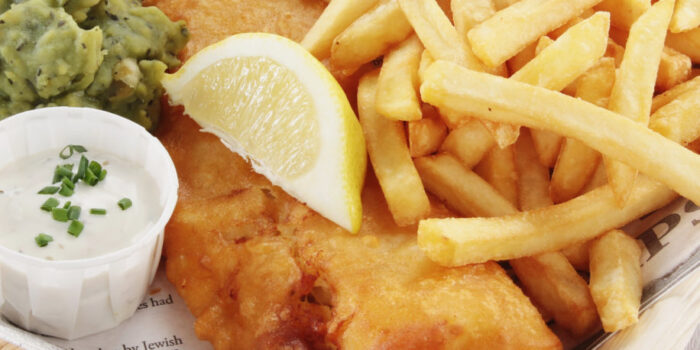
But the New Generation of fish & chips is a far cry from such scenes. Bycatch and locally caught species now play the sustainable leading role. From whiting to dogfish and red mullet, as at the recently opened Amsterdam fish café De Gouden Hoek. Plus an irresistibly crisp batter crust. Either made from classic beer batter, à la Japanese tempura, or based on the equally Japanese panko (breadcrumbs).
Bycatch such as whiting, dogfish or red mullet in a crisp batter crust.
No limp, greasy chunks of potato on the side, but crispy matchstick-thin fries, for example, that you can’t stop eating. And alongside the vinegar, naturally, fresh mayonnaise, such as the French fish classic remoulade. And, if possible, mushy peas (pea purée).
It is actually strange that it took so long for this simple fish fare to catch on here. As early as the 1990s, unsuccessful attempts were made to introduce the British snack here. Even though the Dutch are just as crazy about lekkerbekjes and kibbeling (roughly ‘fish’ in the Dutch style) as they are about fries (‘chips’ in the Dutch style).
Never miss an article again? Follow us on Facebook.
Vinegar
But above all, the vinegar liberally sprinkled over the fish and fries was a major stumbling block at the time. Not anymore, now that our taste is shifting from sweet toward sour, thanks in part to our new national sport after foraging: fermenting.
The fact that the British fish snack is making it now is certainly also thanks to that carnivorous bite that opened up the hospitality market to quality fast food and that is now feeling the panting breath of this very meatless New Kid on the Block first on its neck: the hamburger.
Fish & Chips Shops
Fish & Chips, torenallee 40-08 Strijp-S Eindhoven
Nemo Fish and Chips, Nieuwe Binnenweg 179-B Rotterdam
Proeflokaal ’t Ailand (fish without chips), Haven 49a Lauwersoog
Visjes, Twijnstraat 24 Utrecht
Bos & Lobster, Bos en Lommerweg 313 Amsterdam
The Seafood Bar, Van Baerlestraat 5 and Spui 15 Amsterdam
The Sunken Chip, 39 Rue des Vinaigriers Paris
Check out the recipe for fish & chips from De Gouden Hoek here.
Also read:


