


Foodlingo: Monte Cristo
Food editor at large Marjan Ippel regularly introduces a new or recently re-entered term from the food scene here, the so-called foodlingo. No foodie can do without it. After all, ‘what (not) to speak’ is at least as important in food as ‘what (not) to eat’.

This time: the Monte Cristo sandwich.
We’re increasingly going out for breakfast, brunch and lunch. And preferably 24/7. Thanks to this cultural shift, the sandwich is enjoying a golden age, for example. Especially since its main ingredient, bread, is ‘allowed’ again.
The sandwich has many colorful origin stories, beginning with the eighteenth-century fourth Earl of Sandwich and his gambling habits. This John Montagu, after all, is said to have been the inventor of fillings tucked between crustless triangular slices of bread, which made snacking so convenient during his all-day gambling sessions.
Never miss anything this delicious again? Follow FavorFlav on Facebook.
Pain perdu
Over the centuries, many variations on this original form named after the earl emerged, and they still appeal to audiences today. In recent years, we have seen the Reuben and Cuban sandwiches, the Venetian tramezzino and the French pain perdu (French toast) become popular here. As well as the similarly French croque monsieur and madame.
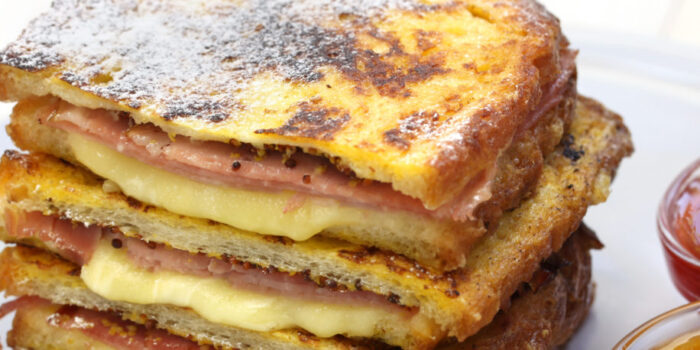
And that is only the tip of the sandwich iceberg. At a time when crossovers (or blurs) in food are extremely popular, an interesting blend of sweet French toast and savory croque is emerging: the Monte Cristo sandwich.
There is also debate over the accompanying condiments
All things French
The Monte Cristo is said to have originated in America as a direct variation on the French croque monsieur. Not such a strange idea, because Americans have always had a crave for all things French. From the 1930s onward, the dish appeared in various American cookbooks, often under the name French (toasted cheese) sandwich. The oldest recipe still known today appears in The Brown Derby Cook Book from 1949.
In the restaurant industry, the sandwich dipped in beaten egg and fried in butter in a skillet, with Swiss cheese (that is, Gruyère or Emmental) plus thin slices of ham, turkey or chicken, is said to have first appeared in 1950s Southern California. And that may well have been at the Brown Derby restaurant in LA—the namesake of the aforementioned cookbook, famous for its clientele consisting exclusively of Hollywood elite.
Disneyland
Anyone who has never heard of the Monte Cristo has never been to Disneyland California, where it still ranks among the most frequently ordered lunch dishes.
Unfortunately, the origin of the name is less clear. Could it, for example, refer to the character from Alexandre Dumas’s novel—also a count, like Mr. Sandwich? Nobody seems to know.
There is also debate over the accompanying condiments. Some recommend fruit jams, jellies and sauces on the side. Others swear by generously sprinkling powdered sugar over the savory sandwich. In the land of the PBJ (peanut butter and jelly sandwich; yet another bread icon), such a savory-sweet crossover should hardly cause surprise.
Okay, time to get started yourself.


