



Golden tip: this Italian penicillin helps with everything

Welcome to Italian flu season. You can tell that flu season has started by the fact that paracetamol, throat lozenges and nasty lemon drinks have been moved to the front of the drugstore, right next to the counter. Italians face flu season slightly differently. I discovered this when my eighty-year-old neighbour knocked on my door with a saucepan full of Italian penicillin. And not a saucepan of medication, no—soup.

Italian penicillin helps with everything
For a few days, I had a splitting headache, a sore throat and a terrible cold. Since I also had little appetite, I lived on cups of tea and paracetamol. Until someone rang the doorbell. My neighbour stood at the door with a handkerchief over her mouth, because she didn’t want to catch it, and a small saucepan held out in her hand. I looked into the saucepan and saw something resembling porridge—or rather, it looked like porridge, but it was tiny star-shaped pasta in broth.
When I asked what it was, she said: ‘the medicine for everything’, in other words, Italian penicillin. This soup is named after the medicine because it is said to have a similar—or perhaps even better—effect. It doesn’t matter whether you can’t eat because of flu, nausea or a broken heart. Italian penicillin helps with everything.
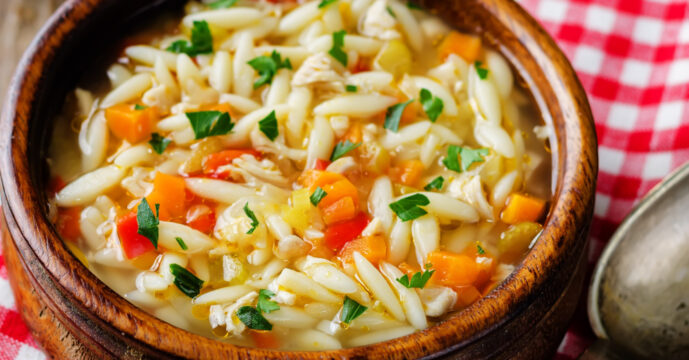
Pastina in brodo
Italian penicillin is a soup consisting of broth, either made from vegetables such as celery, carrot and onion or from chicken, small pasta called ‘pastina’ and, naturally, Parmigiano. In Italy, star-shaped pasta is the best-known variety for making this soup. In the Netherlands, orzo, fregula or alphabet vermicelli probably comes closest. Because the pasta is tiny and smooth, it barely needs to be chewed and can also be swallowed with a sore throat. For the same reason, it is also the first “solid” food many Italians ever ate. After baby food, babies often move on to pastina.
Variations on the soup for flu
There are several variations of this life-saving soup. These days, turmeric is sometimes added to broth for its possible anti-inflammatory effect, although this might be considered a little too unconventional for the average nonna. Sometimes an egg is added to the broth. I had to check a few times whether I had read it correctly, but adding an egg to broth is not unusual for Italians.
The Roman stracciatella is also a soup made from broth and eggs. Italian penicillin also varies in the amount of broth added. Sometimes the soup is more like a porridge with little broth, and butter, lots of Parmesan and black pepper are added. That version is also simply called ‘pastina’. In this form, it comes closer to risotto. Like the one my neighbour made. But it must be said that I really did feel much better afterwards.
Want to make Italian penicillin yourself? Here you’ll find the recipe for ‘pastina in brodo’.
Also read:
- Don’t freeze this
- How to make Sicilian endive soup
- 6x ingredients you can replace with cheaper products
Source: Italiamo


