


Have you heard of kintsugi?
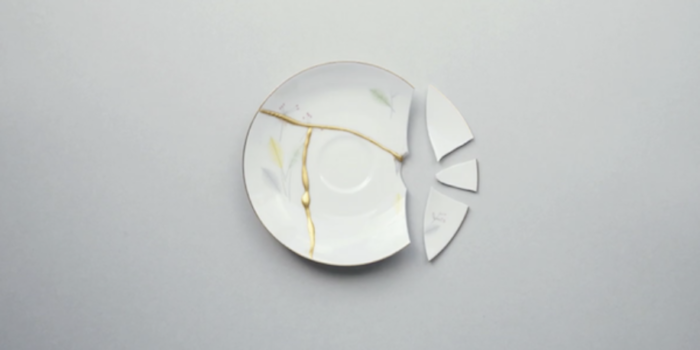
Letting your plate smash into a thousand pieces? The shards almost always end up in the bin. Not in Japan: there, they simply glue the pieces back together. It’s called kintsugi. It’s an ancient technique.

Once upon a time…
… there was a Japanese emperor. He sent his broken teapot back to China to have it repaired there. Well, he must have regretted that. He got the pot back with dozens of cheap staples in it. This could be done better, he thought. And above all, more beautifully. And so his assistants came up with something entirely new: kintsugi. At least, that’s supposedly the story behind the technique’s origins.
Philosophy
Kintsugi is a technique in which cracked or broken crockery is glued back together. Not with staples, putty or superglue, but with liquid gold leaf. Each break is emphasized rather than made invisible.
Some people believe it is more than just a technique. They say it is a philosophy. It shows that damage, dents and cracks are part of the ‘life’ of the crockery and that they are not immediately a reason to throw something away. In fact, gluing it with gold can result in a plate that may be even more charming than it was before, meaning that a break ultimately only makes the whole thing more beautiful.
Modern version
So now we want to drop plates and bowls too. This week’s discovery: a Dutch design brand recently came up with new kintsugi. A kind of inexpensive version using glue that you mix with gold powder. You spread the stuff over the shards and then stick them back together. We want to try it!
Photo: Vimeo, Humade


