



Hot hot hot! Hotpotting: how to do it (+ recipe)
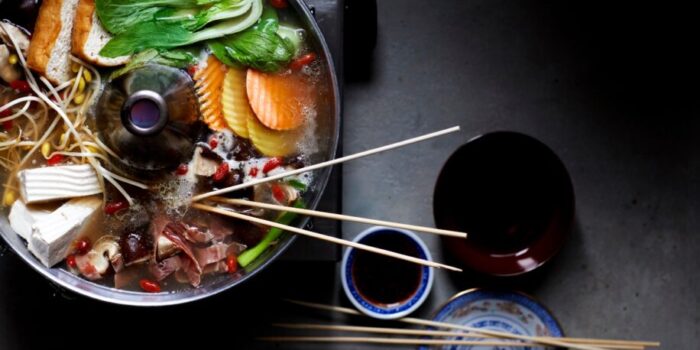
A pot of hot broth in the middle of the table and get hotpotting! Although… hotpotting isn’t something you just do. Because what you cook in the hotpot is at least as important as the soup itself. In his new book Hot Pot, Bas Robben explains step by step how best to approach it, what you need for it and, of course, the most delicious recipes to get started right away.

The origins of hotpotting
The hotpot probably originated in the Chinese city of Chongqing, which borders the popular province of Sichuan. At the time, Chongqing was still part of Sichuan, which is why Sichuanese food is still eaten there. Dockworkers working around the Yangtze River came up with the dish. They bought cheap cuts of meat and cooked them in a pan with fat and chillies. At least, that’s how the story goes. In reality, archaeologists discovered that hotpots were already being used during the Zhou dynasty (1046–256 BC). Bas follows the history described by writer Fuchsia Dunlop: she says that the first hotpot restaurants appeared from 1930 onwards, but that the dish only became wildly popular with the entire Chinese population from 1990 onwards.
Hotpots can be found not only in China, but also in Vietnam, Korea, Japan, Taiwan and Thailand, among other places. In this book, Bas has created a colourful collection that you won’t tire of quickly. Go all out with a decadent and fiery Sichuanese hotpot packed with spices and a wonderful abundance of dried chillies and green Sichuan peppercorns. At the same time, he also gives you the recipe for a quicker version, allowing you to put a hotpot on the table on weekdays too. Because once the soup is ready, you can quickly sit down to eat.
What you cook in the hotpot is at least as important as the soup itself. You can make it as simple or challenging as you like. In the Chinese supermarket, you’ll find ready-to-use pork, lamb or beef sliced paper-thin, dozens of types of fish balls, dozens of tofu varieties and a green rainbow of crunchy vegetables. But you can also get to work yourself: roll shrimp and meatballs, fold kimchi-tofu dumplings, marinate beef tenderloin and knead rice balls together.
What do I need for a hotpot?
Hotpotting as a group activity takes place around a pan of bubbling broth in the middle of the table. So you need a pan and a gas burner or electric hot plate.
The pan
Feel free to start with a 3- to 4-litre, half-height cast-iron pan. You probably already have one and it works on both an electric hot plate and a camping gas stove. If you’re going to hotpot more often, it’s worth browsing online. Bas likes to combine an invigorating spicy broth with a milder broth. That’s why he has a round metal hotpot pan divided in the middle by a metal divider. You can really only use it for hotpotting, so you’ll need to have room for it in your cupboards. For enthusiasts, there are also hotpot pans with space for three, four or even nine (!) broths.
For Japanese hotpots, he doesn’t use a metal pan, but an earthenware one. This is also called a nabe and can be found in more and more cookware shops. Bas’s is from the Japanese chain Muji (with shops in Germany and the United Kingdom, among other places), but you can already find them at various cookware shops too. When buying a nabe, make sure you get the right size. A two-person nabe really is for two people, and a four-person one for four. You can’t really make food for two in a four-person pan, because of the pan’s capacity and the recipes designed for it. The earthenware nabe only works on a gas burner, preferably with a flame diffuser underneath.
Electric or camping gas stove?
Bas prefers to use an electric hot plate, for two reasons. “The first is that you never have to go to the camping shop or hardware store for gas canisters. The second is that you can regulate the temperature of an electric hot plate better. I have a simple version with a display that can be set to as many as ten different levels. Is your hotpot boiling too vigorously? Press the minus button twice. Is the soup refusing to come to the boil? Press the turbo button. It’s ideal. The only thing that doesn’t work on an electric hot plate like that is an earthenware pan such as a Japanese nabe. I can live with that, but if you’re going full-on Japanese with your hotpotting, you’ll need a camping gas stove.”
Electric hotpot pan
This pan works just like placing a metal hotpot pan on an electric hot plate. It often has two compartments too, for two soups. Really suitable for regular hotpotters, but the downside is that the pan is then only suitable for this purpose.
Fishing utensils
No, not for doing anything with fish, but for fishing the ingredients out of the hotpot. You can use strainers or communal chopsticks for this. These chopsticks are longer and larger, and shouldn’t be confused with the chopsticks you use to move your fish balls from the sauce dish to your mouth.
Hotpotting in 5 steps
These instructions mainly apply to Chinese, Taiwanese and Vietnamese hotpots.
1. Place the hotpot on your hot plate and pour in the broth, along with any garnishes. Bring the soup to the boil.
2. Arrange the remaining ingredients to cook and dip in the hotpot on plates around it. Also place the communal chopsticks, strainers and regular chopsticks nearby.
3. Give everyone a plate with a bowl on it and put out an assortment of sauces. Let everyone prepare their sauces according to their own taste. Serve finely chopped garlic, peanuts, chilli and spring onion alongside.
4. Put ingredients that need longer to cook in the hotpot together as much as possible so they finish cooking at the same time. Hold thinly sliced meat between your chopsticks and stir it in the hot broth until it has lost its pink colour. It’s best to cook dumplings last in the hotpot, otherwise the soup becomes somewhat starchy. You can also choose to cook the dumplings in a separate saucepan of water.
5. Dip the cooked ingredients straight into your sauce, blow on them to cool them down and take a bite!
How to make the supermarket hotpot
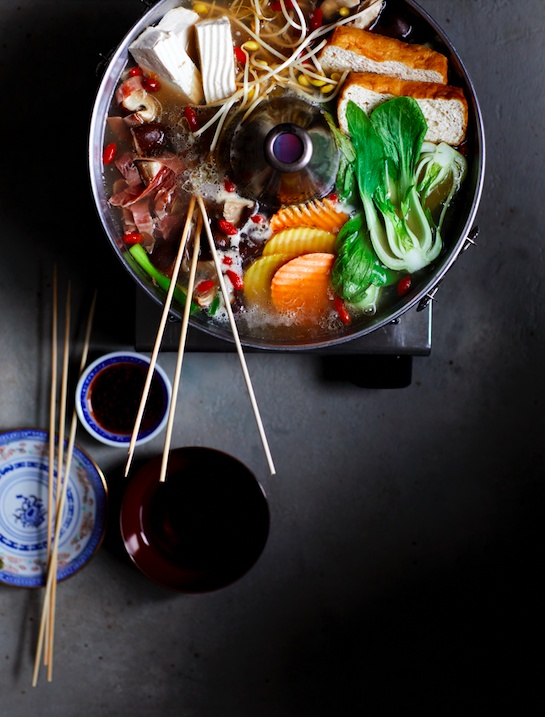
Bas: “For anyone who wants to sit down to eat quickly, or would rather devote their efforts to the ingredients for the hotpot than to hunting down ingredients, I came up with this hotpot. It doesn’t necessarily belong to a particular region of China, but it does contain typically Chinese flavours. I put this recipe together so that you can find all the ingredients in the supermarket (and therefore don’t have to go to an Asian supermarket). The soup gets most of its flavour from the dried Parma ham. Yes, an Italian ham. But it’s actually not that different from Chinese dried ham.”
- Put the Parma ham, spring onion, ginger, goji berries, garlic and shiitakes in a soup pot. Add the water or broth and bring to the boil. Lower the heat and let the hotpot base infuse for 30 minutes. Then season the hotpot base with enough salt.
- The soup can be poured straight into the hotpot; all the ingredients in it can be eaten.
- Place the hotpot in the middle of the table on a hot plate. Arrange the tofu, pak choi, corn on the cob, bean sprouts, prawns, beef and chicken skewers, beef, chicken breast, potato slices and sweet potato on plates and put them on the table. You can now start hotpotting.
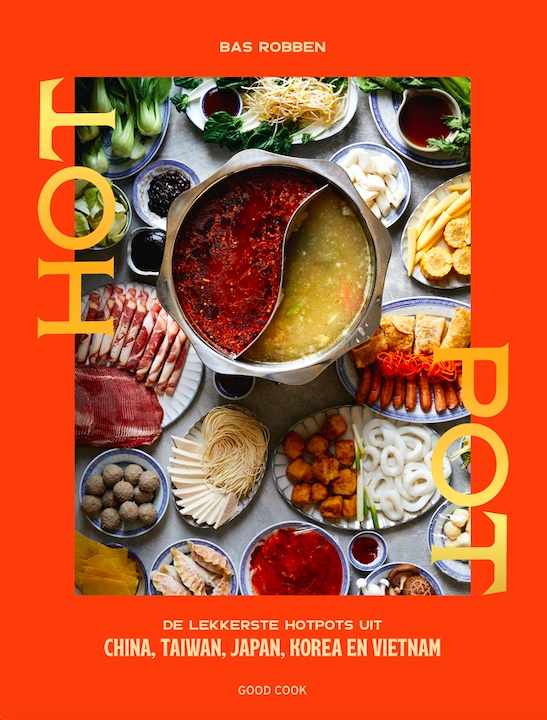
Title: Hotpot
Author: Bas Robben
Price: €22.50
Publisher: Good Cook
Also read:


