


“In my wheelchair, I’m not a guest but a problem”
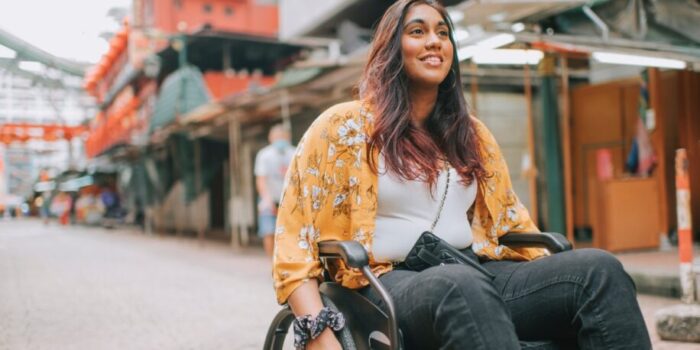
While others get excited about eating out, Anne mainly feels tense. Not because she doesn’t enjoy it, but because beforehand she never knows whether she’ll be able to get inside at all. “I’ve been in a wheelchair since I was 29, because of a progressive muscle disease. Since then, the threshold to a restaurant has become much higher, both literally and figuratively. Literally, because those thresholds are often still there. And figuratively, because time and again I run into walls – in the form of discomfort, misunderstanding or simply complete ignorance.”

Anne: “I know: the Netherlands is a modern and developed country. But when you’re in a wheelchair, it sometimes feels as though you’re living in another era. As though accessibility is something new. As though hospitality doesn’t apply to people like me.”
Thresholds that are too high and narrow corridors: “Sorry, we don’t have room for wheelchairs”
“It starts at the entrance. That four-inch threshold? To me, it’s a mountain. And yes, I have a ramp, but it only works if someone helps me put it down. So there you are, outside a restaurant with friends, having to ask a member of staff if they can help you get inside in the first place.
If that works, the next challenge follows: the space. Corridors are often too narrow, tables are too close together, and I regularly bump my wheelchair into a chair or wall. Not intentionally, of course, but it makes you feel clumsy and difficult. And that eats away at you.
A waitress recently said: “You’d better stay at the table by the door; that’s easier.” As though I were a trash can that had to be put in a corner so I wouldn’t be in anyone’s way. That really hurts.”
People talk about me, not to me
“What perhaps affects me most is that people often don’t even speak directly to me. Just recently. I was sitting with my sister in a café. The waitress looked at her and asked: “What would she like to drink?” I was sitting right there! Not in a coma. Not in a glass cage. I simply wanted to order something, just like everyone else.
This happens more often than you think. People sometimes assume that if you have a physical disability, you’re also not entirely mentally capable. Or they feel uncomfortable making contact. But you know what’s really uncomfortable? Being ignored.
There’s nothing wrong with my voice. My taste buds work perfectly well. And I really do know whether I feel like tea or wine. So why don’t they simply talk to me?”
Going to the bathroom is a whole undertaking
“And then there’s the bathroom. Oh, the bathroom. Very few restaurants have a genuinely wheelchair-accessible toilet. Sometimes they say: “We have one downstairs, but we’ll just carry you.” I’m sure they mean well, but I don’t want to be a circus act. I just want to go to the bathroom independently. Like everyone else.
These days, I always have to check whether a restaurant has an adapted toilet. And even when they say it does, in practice it often turns out not to fit – literally. The door is too narrow. The toilet is too high or too low. No grab bars. Or the cubicle has been turned into a storage room with brooms and boxes of wine.
So I sip my drink slowly. Because going to the bathroom has suddenly become a risk.”
My social life is getting smaller because of it
“You might think: then you simply go only to accessible places. But surprisingly few of those exist. Or they’re more expensive, more formal, or simply not where my friends want to meet. So I increasingly opt out. Not because I want to, but because I don’t feel like spending yet another evening dealing with obstacles.
Luckily, my friends understand. But they don’t have to call three times to ask whether there’s a ramp, whether there’s a lift, or whether there’s enough space. They don’t have to worry about whether they’ll soon have to explain that I simply want to place my own order.
Sometimes I feel like a spoilsport, even though I’d really love to join in.”
It could be so much better – if we all gave it a little thought
“Still, I believe it can be different. I’ve had positive experiences too. At some places, you can tell that people have thought things through. There’s a ramp. There’s space between the tables. The staff look at you and speak to you directly. There’s an adapted toilet. And you know what? That doesn’t just make a difference to me. It makes everyone feel welcome.
Accessibility is not a favour. It’s a right. And if we all thought a little more about whom we might be (unintentionally) excluding, this world – and the hospitality industry – would be so much more enjoyable for everyone.
So the next time you reserve a table, ask: “Is it also accessible for a wheelchair?” Even if it’s just to get the conversation started. I’m sure I’ll be very grateful!”
Would you like to share this?
Use the hashtag #iedereengast or forward this article. Because together we can make sure that no one ever has to remain standing outside a threshold again – literally and figuratively.
Read also:
Anne’s name has been changed for privacy reasons. Her real name is known to the editorial team. Would you also like to share a personal story (anonymously!)? You can email us at info@favorflav.com


