


Infuriating: all those spelling mistakes on the menu
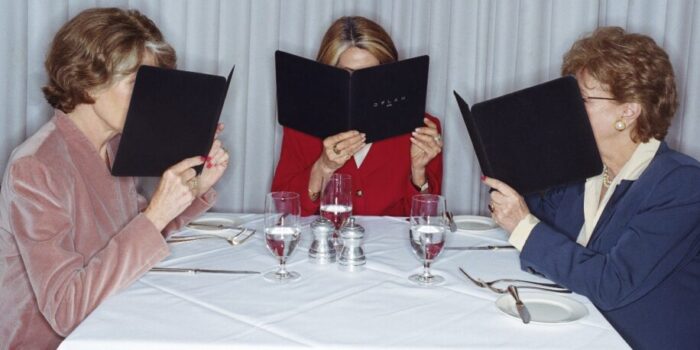
Adeline loves food, lots of it and often, both at home and out. Things usually go well, but sometimes they don’t. In the series Eddie’s Food Annoyances she shares her observations. This week, she discusses the painful spelling mistakes on the menu.

Once, I saw a ‘surprising combination’ of all kinds of ingredients on a menu. In my mind, a scene unfolded of a chef using a flamethrower to turn something that might possibly have been food into ash on a plate. I’m rather visually inclined, apparently even when there’s a little spelling mistake on the menu. Spelling mistakes on a menu—I have a bit of a thing about them. Maybe it’s professional deformation, or maybe I’m simply right. It should just have a double r, after all—even though this spelling was quite surprising for a top-class establishment.
Not much good
Crab, which is simply crab. Slibtong, aka sliptong. Advocado, not to be confused with the real avocado. Although with the latter, I would immediately get up and leave if I saw that extra ‘d’. If you handle spelling that carelessly, the food probably isn’t going to be much good either. I find spelling mistakes on a menu comparable to a molecular scientist who doesn’t understand formulas: it may not go wrong, but it can. And if you can’t even spell an ingredient properly, what will it look like on the plate later?
350 (!) people per week
‘Tomaten soep’—another one. I understand that you take tomatoes and something soupy and liquid, and that it only becomes tomatensoep after puréeing, but I would really like to read beforehand what it is supposed to become. I can almost hear you thinking through the screen now: “A chef should be able to cook, not spell. Stop nitpicking.” And I understand that reasoning, but then again, I don’t. It’s actually a simple calculation.
Let’s say 35 tables to be sold per evening and multiply that by two, making 70 dining souls. Times about five. That’s 350 (!) people per week reading a spelling mistake, when you could have prevented it by having one living soul who can spell check it. That’s really my point. What about all those divine dishes if you can’t even be bothered to proofread your sales page? Because honestly, the menu is simply hard-core sales.
Yakatori vs. Yakitori
And in the end, it turns out once again that I should just keep my mouth shut, because while Googling just now I discovered that it isn’t yakatori at all, but yakitori. So I’ve apparently been ordering it wrong all this time, and some chef has surely picked up on that somewhere. I think it hurt for a moment. By the way, it’s going to be quite a job from now on to keep tallying how many restaurants have that wrong on their menus.
Read also:
- Eddie’s food annoyances: that the food abroad is tastier, but I live here
- Eddie’s food annoyances: one of those pretentious waiters at the table
- Eddie’s food annoyances: wet tea bags lying around


