



Is this the trick for the perfect fried egg?
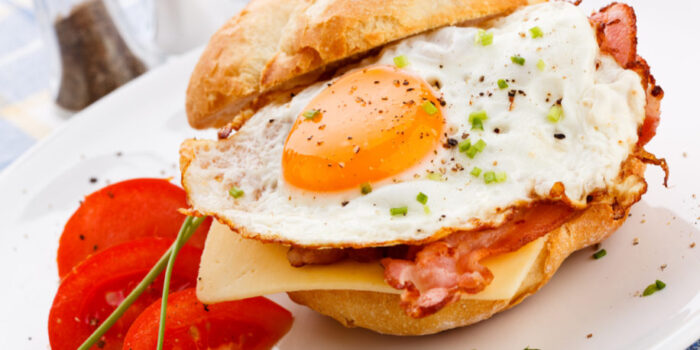
Are you always looking for the best way to fry an egg too? It sounds so simple, but if you really care about food (like we do), you love tips on how something can also be done differently—and maybe even better! This time: a wondrous trick for the perfect egg yolk…

A different egg for every occasion
We fry, boil and scramble quite a few eggs, and can count ourselves lucky to know that every occasion calls for a different kind of egg. Luxurious breakfast? Fluffy scramble with bagels and salmon. Light lunch? Salad of crushed cucumbers, chickpeas, and a perfect boiled egg. Retro drinks party? Deviled eggs until you see yellow. Quickie dinner? Fried rice with spring onions, soybeans, chili oil and a fried egg with a crispy edge.
H-ei-ly grail
And even that last one—the humble fried egg—can involve a search for the ultimate version. Just a little too short and your yolk is soft, but the white is still snotty. Just a little too long and you’re left with a dry, mealy yolk. My trick is to turn the heat fairly high so the underside gets wonderfully brown and crispy, then put a lid on the frying pan for a moment so the yolk steams until cooked before the bottom burns. Then let the steam escape again and tadaaa.
A piece of cake
And then I came across this wondrous tip! Chef Michael Gallina puts the eggs in their carton straight into the freezer. He leaves them there for at least 48 hours, then lets them thaw in the fridge the night before using them. If you then crack them into the frying pan the next day, the whites have thawed loose and liquid again, while the yolks retain a somewhat thicker, jelly-like texture.
They cook through this way too, he says—while the whites are cooking, you can add a knob of butter to the pan and slowly spoon the hot butter over the egg to heat the yolk properly as well. This naturally goes against what we’ve learned about freezing, but if someone says it produces fantastic fried eggs, we’re certainly willing to give it a try.
Liquid gold
Gallina even has a name for the thick, slightly runny golden yolk: egg butter. Egg butter?! As in soft yet firm, warm and spreadable egg yolk? Sign me up!
Show me, then
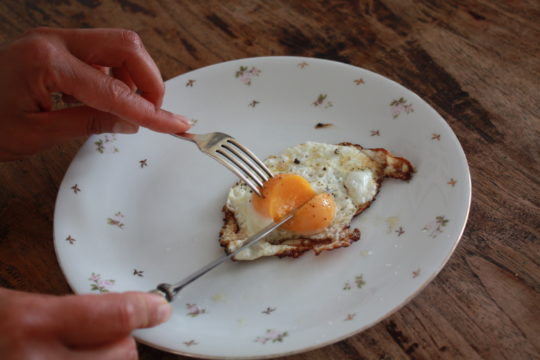
Of course, I had to see this with my own eyes. Even though I normally wouldn’t freeze raw eggs, I did it anyway, and they didn’t crack in their shells. And that promised egg magic? I have to admit: I wasn’t immediately enthusiastic, mainly because of the appearance. The yolk came out as a fairly hard, tall little dome, and because we’re clever little creatures, we immediately get suspicious when our food looks different from what we’re used to.
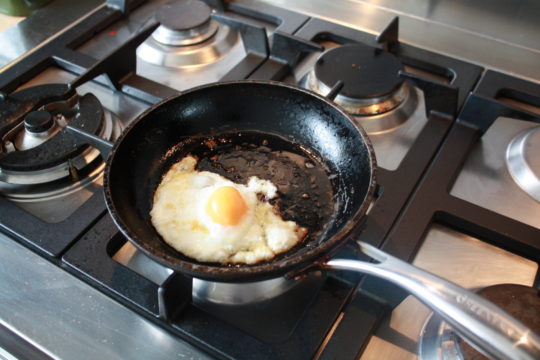
On the first attempt (I had frozen three), the white was cooked after the normal frying time, but I didn’t dare take the yolk off the heat: after being frozen, it hadn’t quite come up to temperature in the pan and remained pretty cold. So on the second attempt, I put a lid on the frying pan to trap the heat and make sure the yolk would warm through. And I have to admit: that yolk really did become buttery, and it spread exceptionally well. Here’s the result!
Next time
Would I do it this way again? I don’t think so. Putting eggs in the freezer isn’t much effort in itself, but it was still a little nerve-racking, and above all it meant waiting a long time (three days, after all) for a fried egg that I already know how to make perfectly well without any tricks. Nevertheless, it was a great little experiment!
Read also:
- Fried egg 2.0 with this top hack
- How to: steam eggs
- Why you shouldn’t fry meatballs in an egg carton (and how to do it)
With thanks to: The Kitchn


