


Knife sharpener on the go
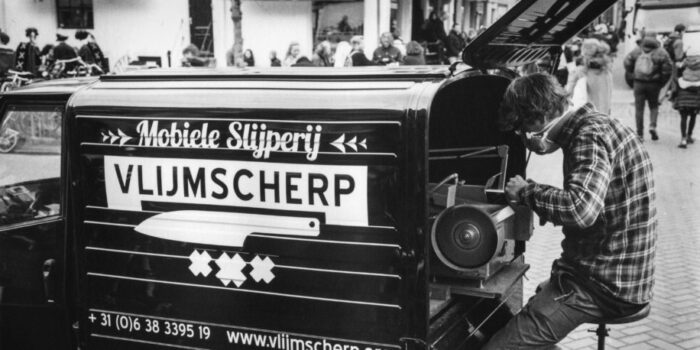
There it is, a black Piaggio Ape, simply parked on the pavement on Jan Evertsenstraat in Amsterdam. From the back, someone is working intently with a knife. Curiosity wins out over haste. It turns out to be Olle Jansen, who travels all over Amsterdam with his company Vlijmscherp to sharpen knives on location. An old-fashioned knife sharpener, but in a completely new guise.

He trained as a chef. He grew up on Texel and left for Amsterdam at the age of eighteen. He now works at Proeflokaal Defour and also sharpens knives. How did that come about? “I was in the kitchen one day and had knives that needed sharpening. It turned out it would take a week. Then I thought: this can be done better and faster,” says Olle. He then buys a sharpening machine, gathers information from a sharpener, scours the web, watches countless YouTube tutorials and practises endlessly. There is no longer a blunt knife to be found anywhere near him. And lo and behold, since September 2015 there has been Vlijmscherp.
There is no longer a blunt knife to be found anywhere near him
Call
Every Friday he is at De Kweker, the food wholesaler at the Food Center site in Amsterdam West. While the hospitality industry does its shopping, Olle sharpens their knives. He is also at Divine & Delicious on Hoofddorpplein in Zuid every Saturday. In addition, he visits restaurants. Olle: “It’s great fun driving around Amsterdam and getting to look into other chefs’ kitchens.” You can also simply call him, and he’ll come by in his converted Piaggio. His price list starts at € 2.25 and goes up to € 20, and there is a gift card.
Olle’s tip
“The honing steel [a type of large file – ed.] that many people have at home is not meant to sharpen your blunt knife. You use it to straighten the edge again. A sharp knife will serve you well for a very long time if you hone it. A blunt knife is more dangerous than a sharp knife and really needs to go to the sharpener. With a blunt knife, you have to press too hard on the product, causing the flavour to be lost more quickly because you squeeze out the juices. For example, with an onion or a tomato.”
Image: Ferry Verwijk


