


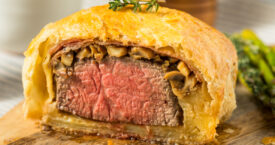
Olive all’ascolana are the tastiest olives in the world (with recipe and wine tip)
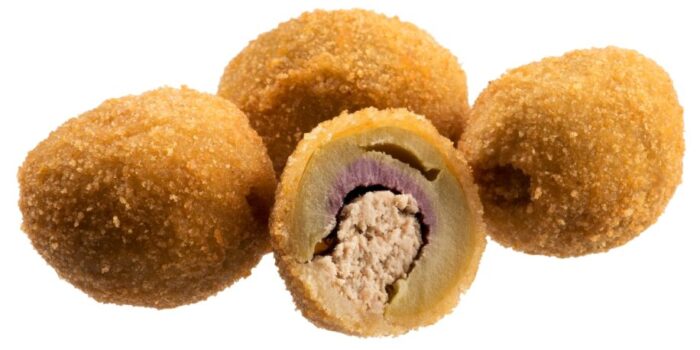
Last week, I visited Le Marche for the first time in my life: the hilly Italian regione nestled between the Adriatic coast and the Apennines. And, as everywhere in Italy, you can eat wonderfully here too. For example, I ate the typical regional dish Olive all’ascolana. Afterwards, I had a stomachache because I couldn’t stop eating these stuffed and deep-fried olives. Here’s a tip and a warning: go and eat Olive all’ascolana soon, but take it piano piano with those little green rascals.

I love Italy just as much as Italians love their own cuisine. Inexpressibly much and intensely, in short. I love the landscape, the hand gestures, the style, the wines, the food. An Italian road trip: you couldn’t make me happier. I even love the Italian motorways, where every petrol station simply has a barista on staff who prepares the most delicious caffè for you. Yes, let that sink in for a moment. And it doesn’t even cost a thing.
During my last road trip, I came face to face with Olive all’ascolana, and I’ve been hooked ever since.
Olive all’ascolana
Okay, let’s get to the point. What exactly are Olive all’ascolana? They are large green olives, specifically those from the Italian city of Ascoli Piceno, which have a slightly sweet flavour of their own. They are pitted and stuffed with a mixture of chicken, beef and pork. As if that weren’t delicious enough, the olives with their meat filling are also breaded and deep-fried. DRIVE ME CRAZY!
The tastiest appetiser
I’m not alone in my love for Olive all’ascolana. For example, cooking goddess Vanja van der Leeden calls them ‘the tastiest appetiser and the best invention since the printing press.’ I mean, come on. In her book Italopop (we already shared a pasta with ragù recipe from it here), she gives a quick recipe for sausage meatballs with olives, called Polpette di salsiccia all’ascolana.
Because making Olive all’ascolana yourself is quite a job. And just like making gyoza, it is also very sociable and even relaxing, if I may believe my Italian friends. Sitting together at the kitchen table, each with their own task in the process, then making, portioning and freezing enormous mountains of the stuff.
-
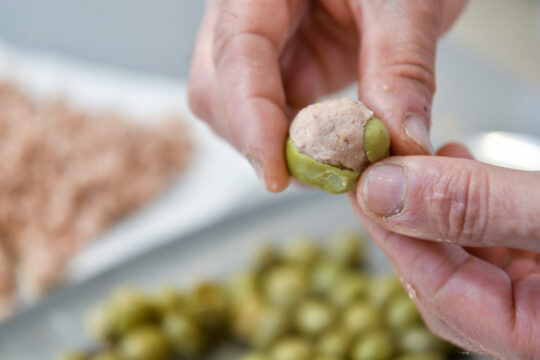
- Olijven vullen
-
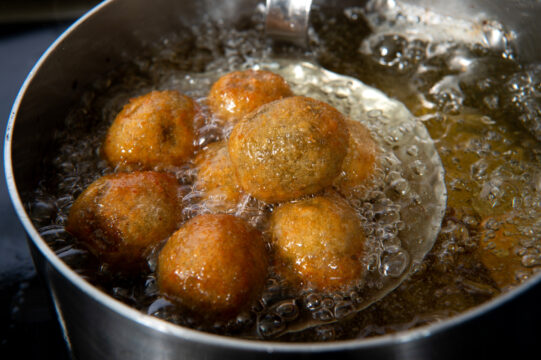

- …en frituren
How to make quick olives with sausage meat
Vanja came up with a version using sausage meat and olives that tastes exactly like Olive all’ascolana. It’s just ready faster. Win-win, and here’s how you do it:
- Cut open the sausages and remove the meat.
- Finely chop the olives. Add them to the sausage meat and season with plenty of nutmeg, lemon zest and freshly ground black pepper.
- Shape the mixture into small oval-shaped balls – use those large olives as a guide. Note: they really must be small balls, otherwise the centre won’t cook through. You’ll get about 18 balls. If you’re cooking for a large group, double the quantity.
- Put the flour on a plate, beat the egg in another plate and put the breadcrumbs on a third plate. First coat the balls in flour, then in egg and finally in breadcrumbs. If desired, refrigerate until needed. Be sure to take them out of the fridge in good time so they are at room temperature when you fry them.
- Heat a generous amount of neutral oil in a large pan to 170 °C. If you don’t have a kitchen thermometer, drop a piece of olive into the oil; if the oil bubbles, it is hot enough. Deep-fry the balls in batches for 3½ to 4 minutes until golden brown and cooked through. If you have a deep fryer, you can use that too.
-


- Vanja’s Polpette di salsiccia all’ascolana
-


- Italopop, Vanja van der Leeden, Uitgever: Nijgh & van Ditmar
Wine tip: Simone Capecci Ciprea Pecorino DOCG
I ate those fantastic olives at winemaker Simone Capecci’s in Le Marche. His mother had prepared them for us (ah, so sweet!) and we drank his wines with them. Of course, you know Pecorino as that delicious hard Italian cheese, but it is also the name of an Italian grape variety, found in several places in Italy but originally from Le Marche.
Pecora means sheep in Italian (Pecorino – the cheese – is therefore made from sheep’s milk). Some people say that the grapes resemble sheep’s heads; others say that the grape owes its name to shepherds who ate these grapes. I’ve also heard that the grape is called that because sheep love pecorino grapes so much. Oh well, there are many roads that lead to Rome. What is definitely true is that Capecci’s Pecorino is a fantastic wine. Fruity, fresh, mineral and a perfect match for Olive all’ascolana. The wine’s freshness cuts straight through the richness of the olives. Heavenly! No spon, but definitely a golden tip. You can find this wine in all Gastrovino stores, and a bottle costs €16.95.

Read also:
- Thieves steal tonnes of olives in Southern Europe
- Aha! That’s why there’s a little tab on the olive oil bottle!
- Olive oil in pasta water: fact or fiction?


