



Panettone and Pandoro: these are the differences between the Italian Christmas desserts
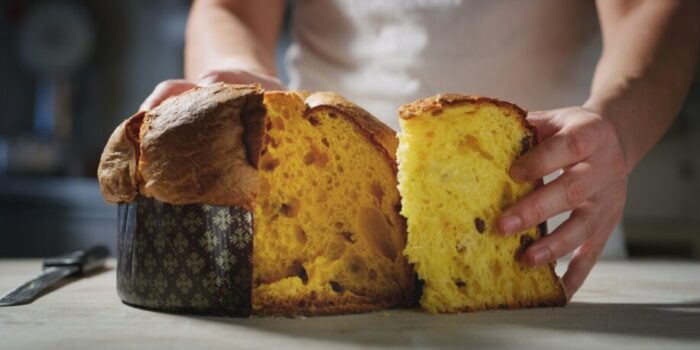
Panettone and Pandoro: they don’t sound like typical treats you’d find on a standard Dutch Christmas table. And that’s true. During the holidays, we traditionally bring out the classic kerststol en masse. But if you celebrate Christmas in Italy, you can’t avoid Panettone and Pandoro. These traditional sweet Christmas desserts are – with a glass of Prosecco on the side – indispensable at an Italian Christmas celebration. They look quite similar, but there are also a number of clear differences. So how do you know whether you have a slice of Panettone or a piece of Pandoro in front of you?

The origins of Panettone and Pandoro
First, a dive into the history of Panettone and Pandoro. Because if you look into it, you’ll already discover a number of initial differences. Panettone originated in Milan. From there, the love of this Christmas sweet bread spread throughout the rest of Italy. There are many theories about the origins of the very first Panettone, so it has never become entirely clear when and how the bake was truly ‘born’. Some tell stories from the 9th century, while others claim that Panettone did not see the light of day until the 16th century.
The most popular story dates back to the 15th century. It concerns a chef at the court of Duke Ludovico Sforza. He accidentally burned his dessert, meaning it could no longer be served. Apprentice chef Toni then gave the duke his homemade sweet bread. When the duke asked about this delicious bread, Toni called it pan del Toni, or Toni’s bread. This is supposedly where the name Panettone came from.
Milan vs. Verona
Pandoro, on the other hand, does not come from Milan, but from Verona. Compared with Panettone, the birth date of this bread is clear: 1894. On October 14 of that year, chef Domenico Melegatti was at the stove and created the very first Pandoro recipe. He based it on pan d’oro, a dessert eaten by many Venetian nobles in the 16th century. Anyone with a little feel for the Italian language can pick out the words pan (bread) and oro (gold) in Pandoro. Golden bread, in other words. And that refers in turn to the golden color of the outside of the bread.
Flavor and texture
Panettone and Pandoro are both essentially made from flour, eggs, yeast and butter. But cut a piece from a Panettone and a Pandoro, and you’ll immediately see that the recipes for these Christmas breads also differ from one another. Literally. Panettone contains pieces of dried fruit and raisins, while Pandoro does not. That, plus the sugar added to Panettone dough but not to Pandoro dough, makes Panettone taste slightly sweeter than Pandoro.
Powdered sugar
You can also counter the claim that Panettone tastes sweeter with a simple explanation. If the Pandoro is dusted with powdered sugar – as is the case with most Pandoros – then Pandoro tastes just as sweet. You almost never see powdered sugar on Panettone. Pearl sugar, perhaps, if the baker is feeling creative. Those with a sweet tooth also often spread a little jam, butter or chocolate spread (Nutella, of course, in Italy) over their slice of Panettone.
Texture
In terms of texture, Panettone and Pandoro both fall somewhere between brioche and cake. Still, you’ll find that Pandoro is a little more cake-like than Panettone. That’s because Pandoro is made with more butter. In any case, a good Panettone and Pandoro should always be silky soft and, above all, not dry.
Shape
Another difference you can see with the naked eye: the shape. At first glance, Panettone looks a little like an elongated muffin. The bake rises quite high in a cylindrical shape, with a spherical ‘hat’ on top. Pandoro has a shape that better suits the Christmas celebration. This bread is baked in the shape of a star. With powdered sugar on top and decorations beside it – sprigs of holly are a favorite – this bake looks as if it has come straight from the set of a cozy Christmas movie. You know the kind, where the whole family sits at the table feasting while snow swirls outside the windows and Christmas carols play in the background.
What do Panettone and Pandoro have in common?
Besides both being Christmas desserts, Panettone and Pandoro have another important aspect in common: virtually no Italian – unless they are a professional baker – bakes these breads themselves. No matter how hard you try, the chances of seeing an Italian laboring over these bakes during the Christmas season are molto piccolo. Very small, in other words. The reason: making a traditional Panettone and Pandoro takes a lot of time. A very long time. Because of the yeast rising, it can sometimes take as long as 30 hours before your Christmas bake is ready. Did you know that in Milan, where some bakers work with years-old ‘mother yeast’ (lievito madre), the baking process can sometimes take as long as 3 days? By then, Christmas is long gone. No, for a good Panettone and Pandoro, Italians would rather go to the bakery around the corner. That leaves them more time to choose a good Prosecco to go with it.
Also read:
- Here you can eat the best Panettone in the world
- Salvo is the nicest and tastiest Italian bakery in the Netherlands
- 8 fantastic Christmas desserts you can simply find in the supermarket
Sources: Mom in Italy, rome-nu.nl, taste-italy.be


