



Picking Hop Shoots
All over the world, wherever hops are grown, the knife goes into the shoots of this key ingredient in beer in early spring. This leaves two shoots on the hop plant, which then begin their climb several metres upwards. Their goal: the hop harvest in September. Only in Belgium are the cut hop shoots not thrown away, but eaten. Food editor at large Marjan Ippel went picking—and, above all, eating.

Where better to learn about hop shoots than in the middle of the fields of hop farm ’t Hoppecruyt in Proven near Poperinge—the centre of hop-shoot cultivation in Belgium. Wout Desmyter’s waterlogged field, where in February there is still little to see.
There are indeed dozens of poles in the clay, with wires stretched between them. But while in summer climbing plants grow along those poles, bearing lush hop cones used to make beer, now we see nothing but clay.
Aphrodisiac
In mid-March, the open-field hop-shoot harvest begins, lasting until early April. But with Valentine’s Day approaching, consumers want this early-season vegetable on their plates sooner. According to tradition, the phallus-shaped delicacy is an aphrodisiac.
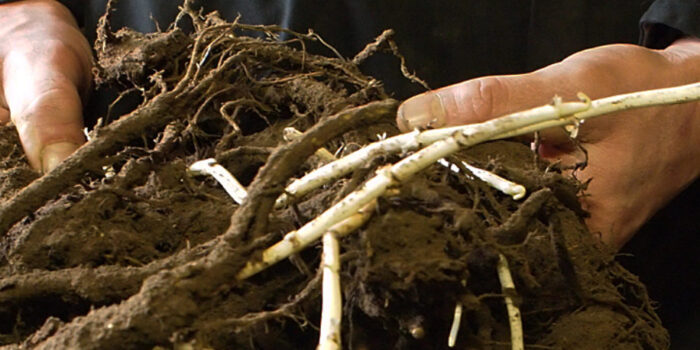
And so the growth of the first hop shoots—‘hommelscheuten’ in Flemish—is forced in the forcing shed. In a dark part of the barn, the hop farmer buries ‘hop root blocks’ (see photo) under ten centimetres of soil, using underfloor heating to get the hop shoots growing earlier.
Forcing shed
The warmth makes white shoots emerge from the roots. To keep those shoots white—just like asparagus and chicory—the layer of soil blocks out the light. This prevents photosynthesis, which would discolour the shoots.
On Valentine’s Day, consumers want hop shoots; according to tradition, an aphrodisiac
The hop farmer lifts out a root block, places it on the picking table and cuts off the shoots. While the open-field hop-shoot harvest resembles asparagus harvesting, in the forcing shed it is more like harvesting chicory.
Labour-intensive
As with asparagus, a large part of the hop shoot is fibrous and therefore unusable. Only the crunchy white tip can be used—about 7 centimetres. With its tip. Without the tip, the hop shoot, like asparagus, has no value. And that value, tip included, can rise considerably. Around Christmas, when the first hop shoots emerge from the forcing shed, they can cost as much as 1,500 euros per kilo. In February they still fetch around 125 euros, and from March onwards the price settles at around 70 euros.
A skilled farmer may pick a kilo per hour, of which even less remains after thorough cleaning. An unskilled journalist manages to harvest barely 25 grams per hour. Fortunately, just as with caviar, you only need a small amount per dish.
Hop cones
The open-field harvest is no less labour-intensive—in fact, quite the opposite. But the flavour of the outdoor crop is even more intense. To keep the emerging shoots white, the clay around the roots is ‘earthed up’: as with asparagus, mounds of soil are made so that the shoot can emerge in darkness. The farmer then has to get down on their knees and use their fists in the clay to cut off the shoot before its tip emerges above the soil.
Only about two shoots per plant remain. From May onwards, they climb upwards against the poles at up to ten centimetres a day, towards the overhead wires, where they develop hop cones until the September harvest.
Ultimately, hop cultivation is all about those hop cones. In most countries where hops are grown, farmers therefore do not go to all the trouble of picking the shoots. This only happens in the area around Poperinge in West Flanders (and also near Aalst).
Hoppy
That makes the hop shoot an exclusive delicacy that is becoming more popular in the Netherlands every year. The first early-season vegetable of the year. An early harbinger of spring. With a flavour that brushes up against that other seasonal delicacy, asparagus, but with a pleasant hoppy bitterness.
That is why hop shoots pair so well with beer. Especially locally brewed varieties. Both alongside the dish and in it. At the Poperinge restaurant ’t Blauwers Huys, for example, I tasted a sabayon made with local St. Bernardus beer. The shoot also pairs well with other early-season delicacies such as veal and lamb. Or with a simple farm egg.
Now let spring finally arrive.
Many Poperinge restaurants serve hop shoots during the season. At the Hop Museum, you can learn about cultivation, and at places including ’t Hoppecruyt you can help with the harvest. Information: Toerisme Poperinge.
Make my favourite, hop shoots with a poached farm egg, yourself.


