


Recipe for an Amazing Quiche Flamande by Top Chef Joris Bijdendijk
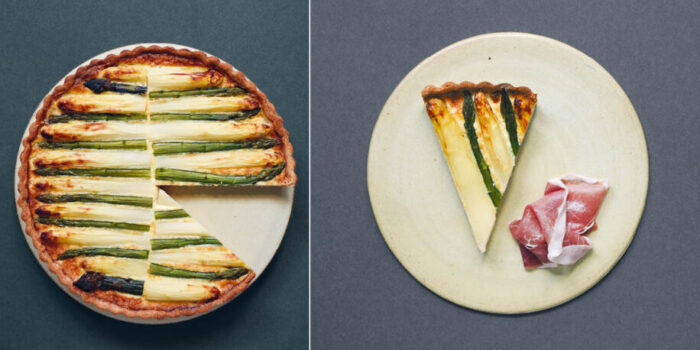
Star chef Joris Bijdendijk cooked three Michelin stars together in eight years. Where he finds the time to also write an (enormously thick!) cookbook is a mystery to us. In At Bijdendijk’s Home , Joris takes you through what is served at his home. With clearly described techniques, he shows you that you can bake the perfect brioche or clean a lobster at home too. He also shares a whole host of top recipes, including this amazing Quiche Flamande.

A good crust
Assuming we are not going to make flour, ham, cheese and butter, et cetera ourselves, quiche still involves three wonderful and challenging cooking techniques. Making the dough, baking the dough and cooking the egg filling. The egg filling is similar to a custard or flan. But how do you get that crust just right? Joris shows you how with this quiche.
How to make the quiche flamande
- Cut the butter into 2-by-2-centimetre cubes.
- Sift the flour.
- In a bowl, mix the cold butter with the flour and salt. The idea is to keep seeing small pieces of butter. I often use a dough scraper to cut the butter through the flour, because otherwise my hands make the butter far too warm. Once it has been mixed into a beautiful crumbly dough, add the icing sugar and almond powder.
- Add the egg and mix well. Stop mixing when everything has formed into a smooth dough so it does not become too elastic.
- Wrap the dough in cling film and let it rest in the refrigerator for at least 30 minutes before use.
- Preheat the oven to 230 °C.
- Roll out the dough evenly to a thickness of 4 millimetres and use it to line a greased tart tin measuring 26 centimetres in diameter and 2½ centimetres high.
- Prick holes in the base with a fork and cover the dough with a sheet of baking paper.
- Place dried pulses or baking weights on top, so the dough does not rise during baking. This is called blind baking.
- Blind-bake for 8 minutes, then bake for another 4 minutes without the baking paper and pulses, so the dough colours and cooks through properly.
- Leave to cool on the work surface.
- Reduce the oven temperature to 180 °C.
- Peel the white asparagus and remove the woody ends. Blanch them for 5 minutes in plenty of boiling salted water. Also blanch the green asparagus; these do not need to be peeled – just remove the very bottom piece.
- Quiche must be firm enough to be cut into slices. To achieve this, use a ratio of 2 eggs per 250 millilitres of double cream.
- Beat the eggs in a bowl.
- Add the double cream and grated cheese, and season generously with salt and pepper.
- Cut the ham into ½-centimetre slices. Thick slices, then. If you have thin pre-sliced ham, place several slices on top of one another.
- Cover the quiche base with the ham slices. Arrange the asparagus, alternating white and green, neatly on top.
- Carefully pour the egg-and-cheese mixture between the asparagus until they are almost submerged.
- Bake the quiche in the centre of the oven, so the top and bottom receive heat evenly, for approximately 20 minutes.
- Then perform the skewer test: prick the centre of the tart with the tip of a thin knife or a toothpick. If it comes out clean, the proteins have coagulated so that they stick more strongly to one another than to the knife, and the quiche is ready. Do not eat the quiche immediately after it comes out of the oven; let it cool first. It will become firmer.

Title: At Bijdendijk’s Home
Author: Joris Bijdendijk
Price: €34,99
Publisher: Nijgh & van Ditmar
Read also:
- 4x the best grilled cheese sandwiches of your life by top chef Joris Bijdendijk
- Why are grilled cheese sandwiches always cut diagonally?
- Make this special grilled cheese sandwich with Gruyère and red wine


