


Recipe: how to make Francis Kuijk’s popular pandan tompouce
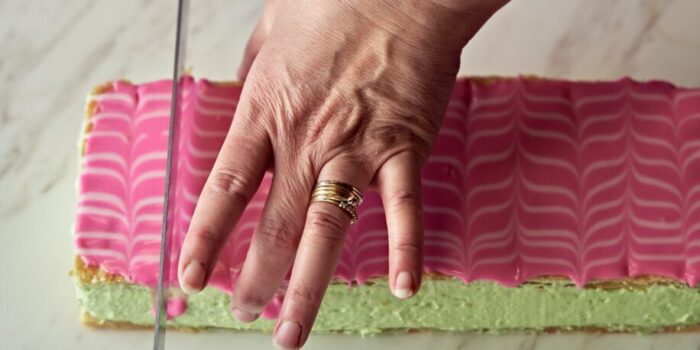
When we think of Francis Kuijk, the first things that come to mind are Indonesian cuisine and Heel Holland Bakt. In her new baking book Manis, she brings the two together and shares recipes for sweet Indonesian treats such as this pandan tompouce. Manis is a special baking book in which Francis explains all the techniques and specific Indonesian ingredients to you step by step.

Francis: ‘In this book, I originally wanted to include an elegant mille-feuille, with various types of cream and fruit. But I’m asked about this recipe so often that I thought it really had to be included. So here it is: my pandan tompouce. You can choose to use pandan flavouring or make your own extract. If you choose the latter, make pandan coconut milk instead of pandan juice and use this as the base for the pastry cream. Your tompouce will have a slightly different colour and flavour, but it will also be delicious. As for the decoration, I keep it simple: icing, store-bought or homemade and marbled.
One more thing: this is a basic recipe for quick puff pastry (rough puff). It doesn’t have as many (or as clearly defined) layers as classic puff pastry, but it has more than enough for a tompouce. In fact, I hardly ever make classic puff pastry anymore—only this puff pastry. Finally, a tip: the puff pastry can be frozen, so if you’re going to make it anyway, prepare a double batch.’
How to make the pandan tompouce
- In a bowl, combine the flour, salt and butter with a knife until the butter is coated with flour (but is still in cubes or clumps).
- Pour in about three quarters of the water. Mix well with a knife until the dough comes together. Only add the rest of the water if necessary. Knead the dough by hand into a ball.
- Wrap the dough ball in cling film and let the dough rest in the refrigerator for 20 minutes. (The butter should still be in clumps in the dough.)
- Lightly dust your work surface with flour. Roll out the dough into a rectangle measuring approximately 30 x 10 cm. (When rolling, make sure you don’t stretch the dough, but gently roll it flat.) Use a palette knife or chef’s knife to straighten the edges. Lightly dust the dough with more flour if it sticks (no butter should be exposed).
- Fold the bottom quarter towards the middle and the top quarter towards the middle as well. Fold the dough in half (you now have 4 layers of dough on top of each other). Check once more that no butter is exposed. Wrap the dough in cling film and let it rest in the refrigerator for 20 minutes.
- Lightly dust your work surface with flour again. Place the dough in front of you with the folded edges on the left and right. Roll out the dough and fold it again as described in step 3, then fold it as described in step 4. Wrap the dough in cling film and let it rest in the refrigerator for 20 minutes.
- Repeat the rolling and folding 2 more times. After the fourth time rolling and folding, the dough should no longer look streaky. Let the dough rest in the refrigerator for at least 30 minutes or until ready to use.
Bake the puff pastry
- Preheat the oven to 180 °C convection. Line a baking tray with baking paper.
- Roll out the dough into a rectangle measuring approximately 30×24 cm. Generously prick holes in the dough with a fork. Place the dough on the baking tray.
- Bake the puff pastry for 20 to 30 minutes until cooked through and golden brown. (Don’t worry if the puff pastry really rises or develops air bubbles here and there. You can press these flat later when you fill it, if desired.)
Make the pandan cream
- Heat 450 ml coconut milk, the sugar, vanilla and pandan flavouring in a saucepan, stirring occasionally, until the sugar has dissolved.
- Meanwhile, make a slurry with the custard powder and 50 ml coconut milk.
- Pour a little of the warm pandan coconut milk into the slurry (to temper it), stir well and pour the slurry into the pandan coconut milk in the pan. Bring the liquid to a boil while stirring and let it boil for 1 minute. Immediately pour the hot custard onto a plate, place a sheet of butcher’s film directly on top (to prevent a skin from forming) and let it cool.
- Beat the cooled pastry cream until smooth with a hand mixer and pass it through a fine-mesh sieve if necessary. Place the gelatine leaves with the water clinging to them in a small bowl and gently heat them in the microwave or in a pan on the stove until the gelatine melts. Let them cool until lukewarm. Use a whisk to thoroughly stir the lukewarm gelatine into the pastry cream.
- Fold the whipped cream into the pastry cream in three batches. Spoon the pandan cream into a piping bag. Store the cream in the refrigerator until ready to use.
Make the tompouce
- Place the puff pastry sheet in front of you and neatly trim the edges using a ruler and pizza cutter. Cut 2 equal strips lengthwise along the puff pastry.
- Place one strip of puff pastry in front of you with the uneven side facing up. Pipe the pandan cream on top (I pipe 2 layers on top of each other, reaching a total height of 5 to 6 cm). Place the other strip of puff pastry, with the uneven side facing down, on top of the pandan cream. Press down gently and use a palette knife to smooth the sides.
- Heat the icing and spoon some into a piping bag (this portion will remain white). Colour the rest of the icing with pink or red food colouring. Spread the pink icing over the puff pastry. Snip off the tip of the piping bag with the white icing and pipe horizontal lines across the pink icing. Use a cocktail stick to draw lines and create a marble effect. Place the entire tompouce strip in the refrigerator for 2 hours to set.
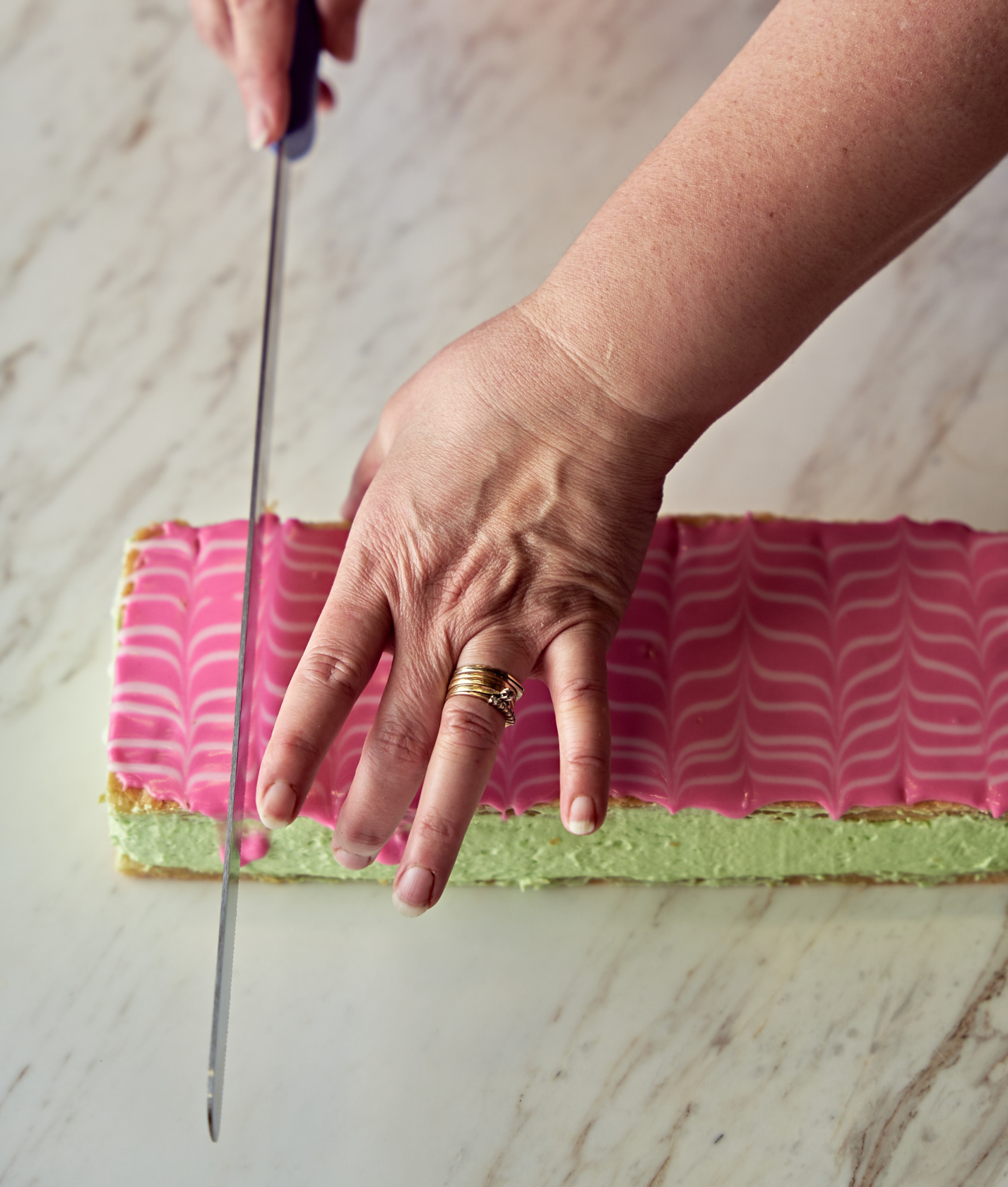
- Cut the tompouce into portions. Do this by first scoring the top strip and then cutting all the way through.

Title: Manis
Author: Francis Kuijk
Price: €25.95
Publisher: GoodCook
Read also:
- Deliciously indulgent: Hema’s tompouce iced coffee
- Brilliant: Albert Heijn is going to sell ‘snack-sized tompouce’
- Tested: this is the tastiest tompouce from the supermarket (and the worst!)


