



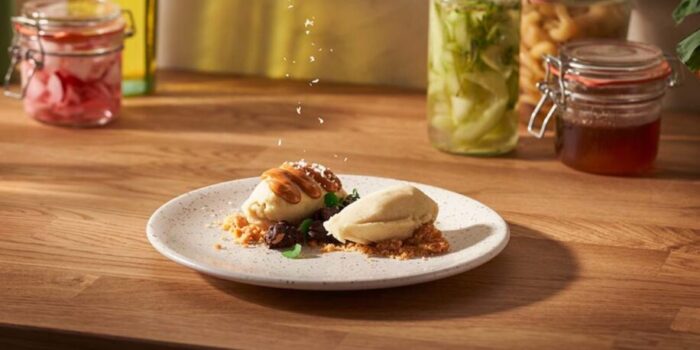
Recipe: how to make truly delicious dulce de leche mousse with banana ice cream
Be honest: when you’re happily munching on a ‘standard’ chocolate bar, or knocking back your much-needed morning coffee, do you ever think about where the cacao or coffee beans came from? Probably not. Unfortunately, many of the things we enjoy come with a bitter aftertaste—and we mean that figuratively. The working and living conditions of the people at the source of the treats on our shop shelves are often appalling. Fortunately, there is something you can do about it.

More and more brands are committed to fair living conditions for all kinds of growers, such as cacao farmers who make it possible for us to find chocolate in shops at all. Surely we all want to keep it that way, preferably in a manner that ensures it remains possible in the future too?
Deliciously fair
One organisation also committed to this cause is Solidaridad. Their focus includes cacao, coffee, bananas and tea. They work to ensure that the people at the foundation of these virtually indispensable luxury products receive fair prices for their goods, and they are also committed to sustainability. Did you know, for example, that women usually do the heavy physical work in the tea sector? As a result, they are more at risk during severe weather and are more vulnerable to illness.
We previously wrote this article about the problems in banana cultivation. Banana plantations are vulnerable to diseases such as fungus. Solidaridad teaches farmers to apply proper hygiene so that diseases can be prevented. However, this is not a solution to the problem; scientists are still looking for a structural solution.
Doing your bit
As a consumer, choosing products with a quality mark such as fair trade, organic or Rainforest Alliance also allows you to do your bit. The BitterSweet theme makes it clear that this does not mean denying yourself anything—in fact, you can make incredibly delicious things. Also important: Solidaridad is not trying to place all the responsibility on you as a consumer, as they are working hard on European legislation. That may still take a long time; in the meantime, it is good to raise awareness.
Bittersweet stories
Many of the products we use almost every day, such as coffee, tea, chocolate and bananas, are grown by farmers in tropical countries. The BitterSweet campaign and one-off magazine of the same name have now been created to give the stories behind our daily groceries more visibility and offer a glimpse into the often difficult lives of these farmers. You can order it at www.solidaridad.nl/magazine. It also includes tips for brands that work directly with farmers, pay them fairly and help them produce sustainably. There are also some wonderful recipes.
Get cooking
As mentioned, the magazine contains recipes for making incredibly delicious desserts. And if you have time to really go all out, we’re sure we can share this recipe for utterly delicious dulce de leche mousse with banana ice cream with you!
SHOPPING LIST FOR 4 PEOPLE
- 200ml condensed sweetened milk
- 250 g white chocolate
- 330 ml whipping cream
- 3 eggs (55 g egg yolks)
- 300 g sugar
- 3 ripe bananas
- 1⁄2 tbsp lemon juice
- 120 ml maple syrup
- 1 vanilla pod
- 75 g coconut oil
- 150 g (cream) butter
- 250 g flour
- 15 g coconut flakes
- For decoration: chocolate-covered peanuts and pea shoots
EQUIPMENT
- Medium-sized saucepan
- Thermometer (not essential, but useful)
- Ice-cream maker or food processor
- Scales
- Oven dish
- Baking paper
- Freezer-safe container
DULCE DE LECHE MOUSSE
- 100 ml water
- 200 ml condensed sweetened milk
- 250 g white chocolate
- 150 ml whipping cream
- 55 g egg yolks
- 50 g sugar
METHOD:
- Make the dulce de leche by boiling a can of condensed milk in a saucepan generously filled with water for 4 hours. You can also choose coconut milk instead of cow’s milk.
- Make a ganache with the white chocolate.
To do this, bring the cream to the boil, remove the pan from the heat and pour it over the white chocolate. Stir everything with a whisk or hand blender until smooth. Leave it to set and cool for a while. - Beat the egg yolks in a bowl for at least 10 minutes, until they become white, airy and increase in volume.
- Heat the water with the sugar in a small saucepan over medium heat to create a syrup. Once it reaches 118 °C*, gradually pour it into the egg yolks and mix everything on low speed.
- Stir in the ganache with a spatula.
- Whip the dulce de leche so that it becomes lovely and soft. Set half a cup of dulce de leche aside for decoration.
- Mix the ganache and the syrup-mixed egg yolks with the dulce de leche.
- Leave it to set in the refrigerator for 4 hours.
BANANA ICE CREAM
- 3 ripe bananas
- 0.5 tbsp lemon juice
- 120 ml maple syrup
- 1 vanilla pod
- 180 g whipping cream
METHOD:
- Peel the bananas, cut them into pieces and add the lemon juice.
- Place the banana pieces in a tightly sealed container and put it in the freezer.
- To make the ice cream, blend the frozen banana pieces finely in a food processor. Make sure the mixture keeps moving, otherwise ice crystals may form. (If you have an ice-cream maker, use it, of course!)
- Add the maple syrup and vanilla seeds to the blended bananas. Then slowly add the cream until you have a smooth mixture.
- Put the ice cream in a container and keep it in the freezer for at least 3 hours before serving.
Tip: Don’t have a thermometer? There is a trick for checking whether the sugar is at the right temperature. Use a metal spoon to take a little syrup from the pan and dip it into a bowl of cold water. Knead the syrup into a ball between your thumb and forefinger. As soon as you can make a ball from the syrup that retains its shape—but still feels sticky between your hands—it is 118 degrees. Attention! Shortly afterwards, the sugar will become too hot.
Also read:
- Help, the chocolate industry is overflowing with misery
- Shit: we really have a serious banana problem
- Consumer Association research shows: information about online groceries is often terrible


